Mavic 3 Propeller Guards: Are They Suitable for Enterprise Survey Missions?

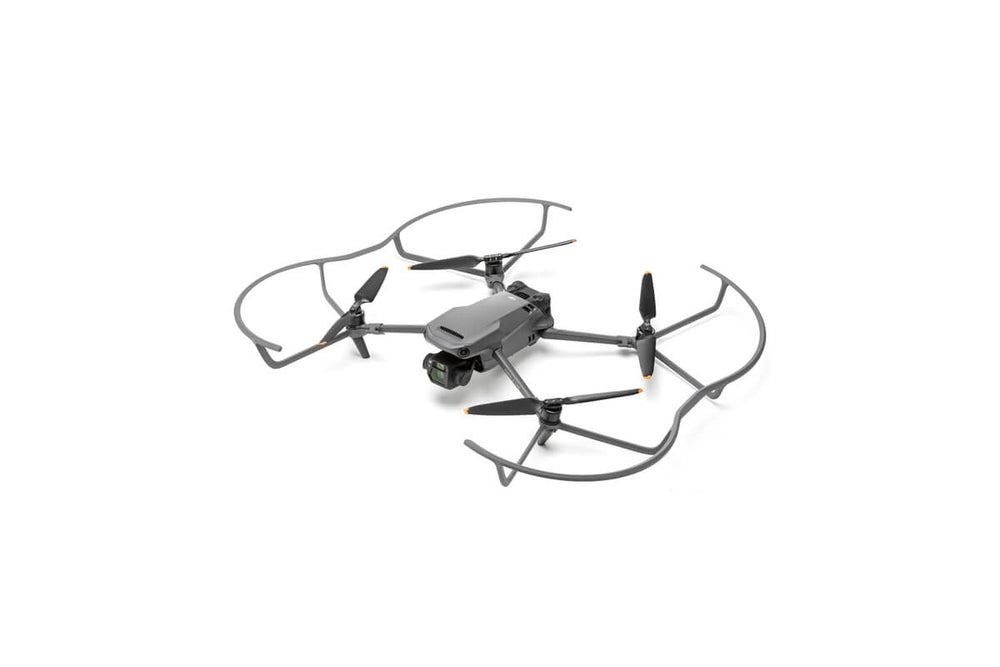
A survey contractor wants to install Mavic 3 propeller guards before flying around rooftop machinery. The guards appear to make an Enterprise drone safer, but the client still expects a full flight duration and accurate mapping without any change to the flight plan. That is a misleading combination of expectations. DJI lists the Mavic 3 Series Propeller Guard as a physically compatible accessory for the Mavic 3 Enterprise family, but adding it changes the aircraft’s installed geometry and mass; it does not make close flight around people, cables or moving structures automatically safe.
Which Mavic 3 guard is actually compatible?
The DJI Mavic 3 Series Propeller Guard uses a dedicated mounting design around the rotor perimeter. DJI’s Enterprise FAQ lists Mavic 3 intelligent flight batteries and propeller guards among the accessories that can be shared between certain consumer Mavic 3 and Enterprise-family aircraft. However, the Mavic 3 Pro propeller-guard design is not the same as the standard Mavic 3 Series guard; DJI’s own Mavic 3 Pro FAQ explicitly excludes the earlier Mavic 3 Series Propeller Guard from its compatible accessories. A label saying “Mavic 3” is therefore insufficient when the aircraft is a Pro, Classic, Enterprise, Thermal or another variation.
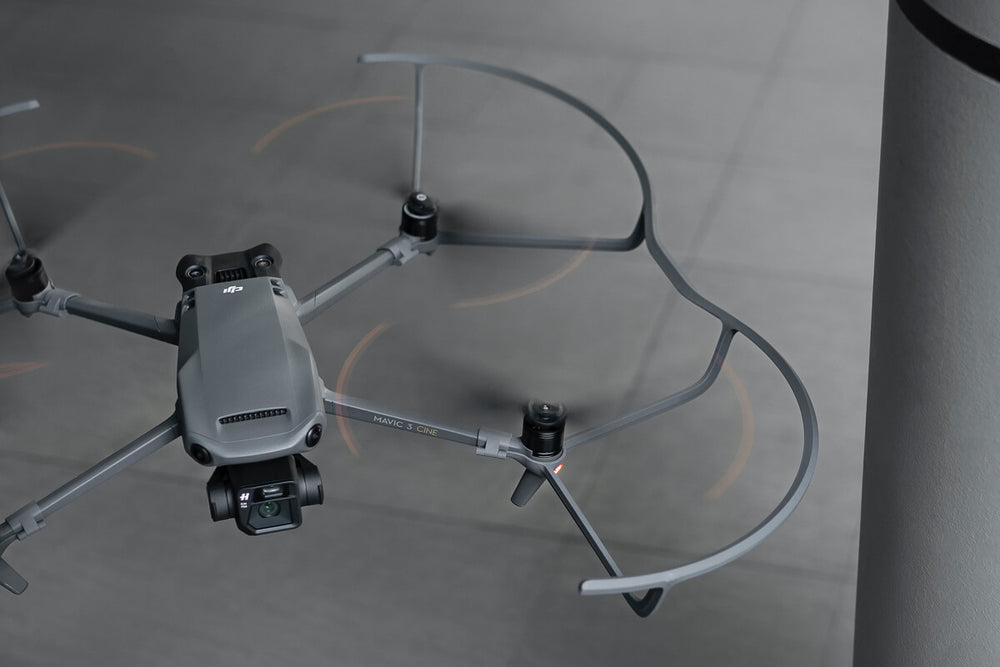
Before purchase, check the aircraft’s full product code, the approved guard model, and the required guard/propeller clearance in its official assembly instructions. A guard that almost fits can still interfere with propellers, block folding or fail to lock correctly under vibration.
What changes after mounting the guard?
| Parameter | What to reconsider | Risk if ignored |
|---|---|---|
| External dimensions | Wider rotor perimeter and obstacle separation | Guard frame strikes a wall even if the aircraft body clears it |
| Takeoff mass | Extra guard weight plus battery and optional RTK/speaker | Exceeding MTOM or certified configuration limits |
| Flight endurance | Potential mass/drag changes and low-speed manoeuvres | Planning around unguarded windless test duration |
| Obstacle sensing | Actual DJI Pilot 2 status and sensor coverage in the installed configuration | Assuming the drone will reliably avoid every nearby object |
| Structural impacts | Guard, motor, propeller and arm inspection after contact | Treating a guard as a guaranteed crash-proof cage |
| Public and industrial safety | Legal operating category, exclusion zones and site procedures | Unapproved proximity to personnel or infrastructure |
The C1/C2 issue for European Mavic 3 Enterprise aircraft
DJI’s EU-certified Mavic 3 Enterprise configurations include a C1 arrangement with a manufacturer-stated 899g maximum takeoff mass using the specified 4,230mAh EU C1 battery and 8658F low-noise propellers, and an applicable C2 arrangement using the 5,000mAh battery with a stated 1,050g MTOM. An added propeller guard consumes part of the allowable total mass. Whether it is permitted in the exact class-certified configuration must be confirmed against the manufacturer documentation and applicable rules; simply fitting an accessory is not permission to exceed the approved MTOM.
Record the actual ready-to-fly mass with memory card, certified battery, permitted propellers, guard and any additional accessories. If the flight plan depends on a C1 class label, do not assume the guard preserves that approval without reviewing DJI’s accepted configuration. The same principle applies to mixing battery models between different regional aircraft classes.
Does a guard make indoor or close-to-people flying safe?
No. DJI’s obstacle sensors have defined environmental conditions and performance limits; thin wires, small branches, reflective or transparent surfaces and poor lighting can still be difficult hazards. A guard protects the outer propeller region from certain contacts, but it does not prevent the aircraft from striking a person with its body, losing position without adequate visual navigation or making an uncontrolled descent after impact.
Inside warehouses, factories or plant rooms, GNSS may be unreliable and the drone may depend more heavily on vision positioning and the surrounding environment. If the lighting, floor texture or geometry does not support stable positioning, a propeller guard cannot solve that problem. Use approved procedures, adequate separation and the correct tool for the confined-space inspection.
Seven-step preflight checklist
- Check compatibility: confirm the aircraft and exact genuine Mavic 3 Series guard. Do not substitute a guard meant for Mavic 3 Pro or another platform.
- Power down: install or remove any guard only when aircraft propulsion cannot start and all rotor blades are stopped.
- Inspect the full mount: check locking features, supports, blade clearance and any damaged or deformed guard sections.
- Measure installed mass: include the battery, all permitted payloads and guard; compare with the approved aircraft configuration and operating-category restrictions.
- Review sensing: inspect DJI Pilot 2 sensor/avoidance status and plan for the possibility of incomplete obstacle detection regardless of guard installation.
- Plan flight reserve: avoid relying on the manufacturer’s guard-free maximum endurance and account for additional manoeuvring, wind and a conservative landing threshold.
- Inspect after contact: any impact that bends or cracks a guard requires examining the rotor, motor, arm and camera before the aircraft is used again.
Which inspection jobs benefit from guards?
For a controlled, authorised task in which the aircraft might brush a stationary surface, suitable original guards can provide a useful extra mechanical barrier. The benefit should be weighed against added dimensions, potential drag, permitted mass and aircraft control quality. For open-air photogrammetry over a large site, the same guard may add unnecessary logistics and reduce already-limited endurance. A low-altitude inspection directly beside active machinery, live power conductors or workers may be unacceptable even with guards; choosing a ground camera or a different platform can be safer.
Make the decision from the hazards and client’s acceptance criteria. A retail page describing “improved flight safety” is not a substitute for the operation’s risk assessment or approved procedure.
Propeller guards do not restore GNSS or guarantee safe vision positioning inside a building. If the inspection requires confined-space flight, also read our explanation of indoor DJI flight without GPS before relying on the physical guard.
Manufacturer compatibility and next step
DJI’s Mavic 3 Enterprise FAQ confirms accessory interchangeability, while the Mavic 3 Pro FAQ documents a separate guard-compatibility limit. DJI’s aircraft specifications give the class-related takeoff limits. Find the relevant genuine Mavic 3 Series Propeller Guard on FalconFly; confirm the installed configuration and operational category before flying near structures.