


Meteor65 Pro II vs Meteor75 Pro II: Indoor Whoop Buying Guide

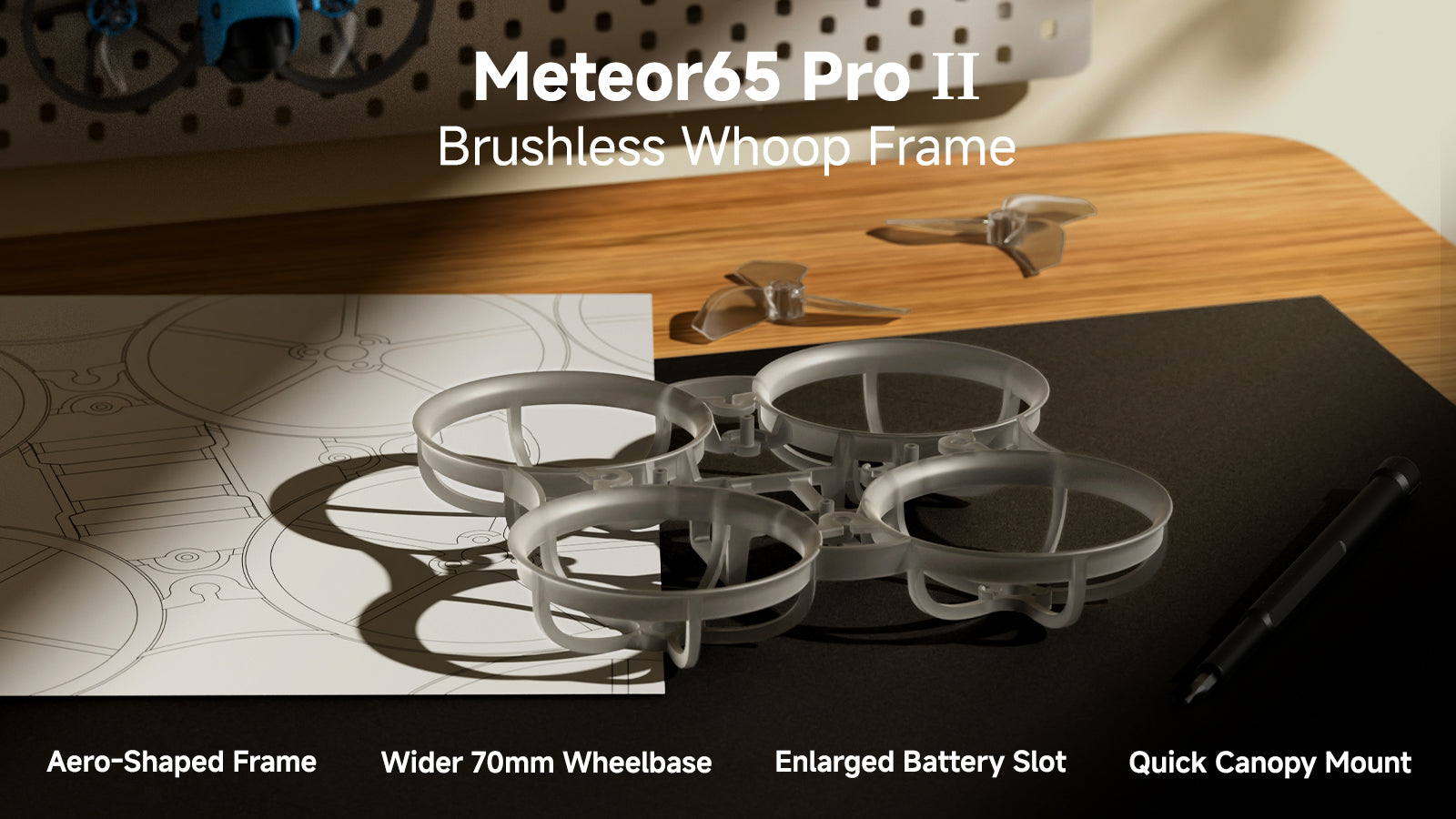
Most tiny-whoop shoppers ask the wrong question: ‘Which model is faster?’ The useful question is where the drone will spend 80% of its flight time. A compact room with furniture rewards precise, low-inertia handling; a larger indoor course may reward more propeller area and stronger recovery. Meteor65 Pro II and Meteor75 Pro II belong to different size classes even when they share a familiar visual design. The differences change clearance, battery fit, crash behavior and the learning experience.
Measure the space, not just the frame
For a small home, consider the tightest doorway, chair gap and corridor turn you will actually fly through. A larger craft needs a wider margin to avoid prop wash striking surfaces. Rotor guard design, not bare prop diameter, determines the real collision envelope. Before purchase, sketch your course and include a wide safety margin near fragile objects or people.
The smaller class generally makes slow training less intimidating, especially if controlled throttle and soft surfaces are priorities. A larger whoop can be more comfortable in spacious halls but its additional size does not make crashes harmless.
How to read the two frame designs
Inspect the official dimensional drawings, battery bay, camera canopy and duct structure. The manufacturer’s diagrams are more reliable than a photo beside a hand. Measure wheelbase, overall width and battery-slot length. Propeller fit requires the correct hub shaft and guard clearance; a propeller advertised for the same approximate class can still foul a redesigned frame.
Consider camera protection: an exposed lens or high-mounted canopy may suffer more from repeated furniture contact. The best replacement-parts plan includes a spare frame, correct props and an appropriate battery lead.
Power delivery, battery weight and practical endurance
One-cell whoop batteries have modest total energy. Even a small battery-mass increase can alter the flight feel noticeably. Compare the actual supplied or recommended battery dimensions and connector, not merely mAh. LiHV chemistry and charge-voltage recommendations require matching the charger mode; never apply a higher terminal voltage based only on a similar-looking label.
Test endurance using a repeatable course and conservative landing threshold. Voltage recovery after landing is not evidence that deep discharge was harmless. Repeated low-voltage dives accelerate cell wear.
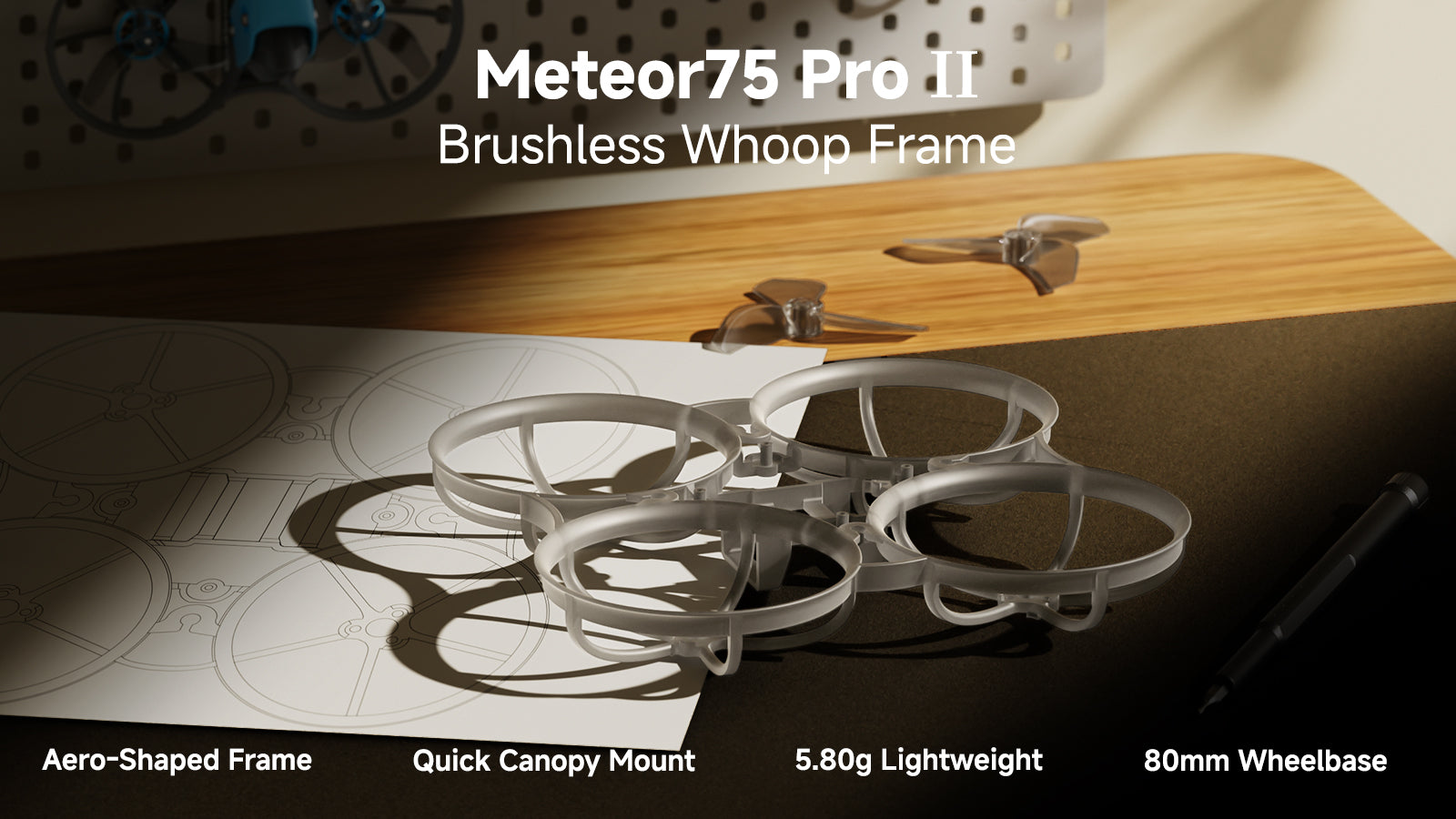
Two pilots, two sensible choices
New pilot, compact apartment: choose the smallest class that offers the camera system and radio protocol you intend to use. Practice hovering, figure eights and gentle landings before tighter gaps. Intermediate pilot, large indoor track: a larger frame may offer a different thrust-to-weight tradeoff and more momentum through sweeping turns. Outdoor pilot: wind can overpower micro aircraft quickly; a tiny whoop is not automatically an outdoor all-weather drone.
Buying checklist and spare-parts trap
Verify the exact II-generation replacement frame, canopy, propeller diameter and shaft diameter. Confirm whether the aircraft is a complete bind-and-fly drone or only a frame kit. Check radio receiver protocol and any required goggles before ordering. A receiver that says ELRS does not confirm it uses the same band as your radio. Review the ELRS compatibility guide and the 1S battery connector guide.
First-flight setup
Charge one battery using the exact chemistry mode, inspect duct guards for cracks, and choose a clear low-damage indoor area. Remove loose curtains or cables near the route. Take off gently and learn how the model responds before enabling more aggressive rates. Land if the aircraft vibrates, props rub the guard, or video quality deteriorates.
Field checklist: before you commit
- Identify the exact product revision and verify electrical, mechanical and firmware compatibility.
- Check weight, fitment, included accessories and what is sold separately.
- Keep a safe baseline configuration and document any settings or hardware changes.
- Bench-test without propellers where electronics are involved; fly only in authorised locations.
- Stop testing if you observe overheating, unexpected movement or radio instability.
Comparison method: choose using an actual indoor course
Instead of relying on a marketing flight video, lay out a safe loop with a low entrance, a broad turn and a precision landing point. Measure the maximum usable width of the narrowest section, then compare it with the manufacturer-documented overall duct width for each version. Add margin for pilot error. A bigger model may travel a sweeping line well but feel less suitable through dining-chair gaps; a smaller model may demand more active throttle correction in air disturbed by furniture. Test in a people-free space with a spotter where appropriate.
Keep identical decision criteria for both aircraft: acceptable low-speed control, camera protection during minor bumps, ability to recover from a missed turn and replacement-part availability. A frame replacement is often less expensive than a damaged camera, so canopy and duct protection should be part of the cost comparison.
Ownership cost beyond the drone
Write down the actual quantity of 1S batteries you want, their compatible plug, the required charger output and the correct replacement props. Some tiny-whoop batteries are sold individually while prop sets may contain multiple CW and CCW pieces. A flight-ready purchase requires a matching radio, receiver firmware configuration and video goggles if the drone does not include them. Check that your charger supports the manufacturer-specified LiHV maximum voltage only when the packs are explicitly labeled for that chemistry.
For an initial practice month, reserve money for propellers, a spare frame and a camera canopy instead of committing all the budget to one higher-spec model. Both frame sizes can be enjoyable; the optimal one is the one you can fly repeatedly in your available space without frequent repair downtime.
Frequently asked questions
Which is better around furniture?
Usually the smaller footprint is advantageous, provided the specific build remains light and predictable. Measure the complete guard dimensions.
Can the two frames share batteries and props?
Do not assume so. Verify battery bay dimensions, connector and individual prop sizes against each model’s official bill of materials.
Is a bigger whoop automatically more stable?
Not automatically. Tune, mass distribution, propeller condition and control settings all matter, especially at low throttle.
Shop and read further
Explore a related FalconFly product or buying guide and our complementary technical guide. Use product specifications and latest manufacturer manuals to confirm the exact version before purchase.
Note: Observations in this guide are conditional; performance depends on equipment configuration, firmware, environment, payload and correct installation.

















