Your First FPV Drone: Tiny Whoop, Cinewhoop or 5-Inch?

The right first FPV drone is rarely the most powerful one. What matters is how much room you have, what you intend to film, and how easily you can repair an inevitable hard landing. A small aircraft that you can fly often will teach you more than a larger machine that rarely leaves its case.
Start with the place, not the specification
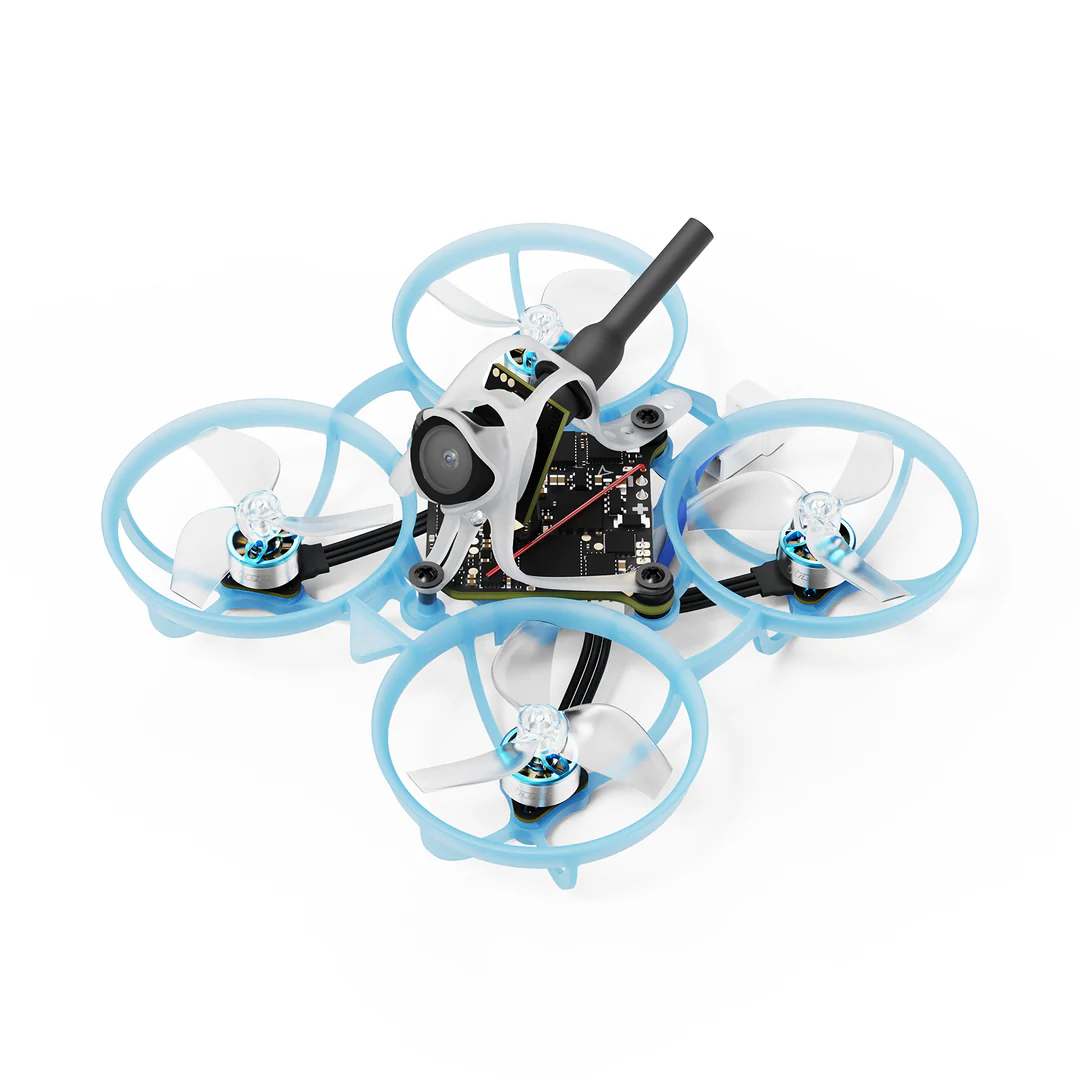
A 65–75 mm tiny whoop belongs to a different category of flying from a 5-inch open-prop freestyle quad. The guarded propellers and light weight of a whoop make it suitable for controlled indoor practice when the environment and local rules permit it. Its limitations are equally important: outdoor wind, battery capacity and carrying extra camera weight. A 5-inch quad offers greater authority in open spaces and a much larger choice of hardware, but carries substantially more kinetic energy and normally requires a more appropriate operating area.
For buyers moving beyond a simulator, a 2–3.5-inch aircraft often deserves closer attention than a 5-inch model. It can be more practical in constrained spaces without feeling like an indoor-only toy. Size is not the whole story, however: an open-prop 3-inch freestyle quad behaves very differently from a ducted 3-inch cinewhoop.
What cinewhoop actually means
A cinewhoop is designed around controlled video capture, often using ducts or guards and a camera-oriented airframe. Ducts do not make a propeller completely harmless, nor do they guarantee quiet operation. They also influence weight, efficiency and handling. A camera-first aircraft can be an excellent choice for careful close-range work where the operation is permitted, but it may feel less agile than an equally powered open-prop build.
For outdoor freestyle, inspect the frame geometry, motor and propeller choice, and battery recommendation. For filming, inspect whether the camera view contains guards or propeller tips, how the camera is damped, and how much usable payload remains once a battery is fitted.
Choose the radio and video ecosystem early
Two purchases tend to outlive your first airframe: the radio and the goggles. On an ELRS-equipped quad, the radio transmitter and receiver must match in band and firmware; DJI goggles handle a separate video link for compatible O3 or O4 systems. Having a DJI O4 camera does not by itself prove that an ELRS radio will bind, and an ELRS receiver does not decide which DJI goggles work.
Before ordering a BNF or RTF package, read the exact variant name. BNF commonly includes a flight receiver but requires compatible radio equipment; PNP often assumes you will provide a receiver or compatible control system. RTF kits may include everything needed to operate that specific kit, but may not be interchangeable with later hardware.
The overlooked cost: batteries, spares and learning time
Budget for more than the aircraft. Depending on the setup, you may need a balance charger, correctly specified batteries, spare propellers, a replacement frame part, battery straps and a safe charging arrangement. Micro drones and 5-inch quads often use different battery connectors and voltage ranges; buying packs by capacity alone is a costly mistake.
Spend time in a simulator, keep a maintenance log, and remove propellers before bench setup and firmware work. Learning repairability and safe handling is part of the hobby, not an optional afterthought. Always check current operating authorisations before flight, particularly in the UAE, where temporary restrictions can change.
A sensible first shortlist
For compact FPV practice, examine the BETAFPV Air65 II. If you want a ready-made FPV kit, compare the BETAFPV Aquila20 HD Kit. If your priority is a larger, purpose-built freestyle machine, consider the GEPRC Vapor-D6 only after checking weight, local flight rules and receiver/video compatibility.
Questions buyers ask
Can a first-time pilot buy a 5-inch drone?
Yes, but it is usually the more demanding route. It needs a suitable operating environment, good orientation and control skills, and careful attention to local restrictions.
Is a cinewhoop suitable for indoor filming?
It can be, where flying is lawful and the space is controlled. Propeller guards reduce some exposure but do not eliminate injury or property-damage risks.
Do all DJI O4 drones work with any DJI goggles?
No. Compatibility is model- and firmware-dependent. Check the current DJI matrix for your exact air unit, goggles and controller.
Is a simulator useful if I buy a stabilized drone?
Yes. A simulator improves stick coordination and emergency response. It is particularly valuable before acro or manual FPV flying.
What should I buy alongside my first drone?
Start with the correct batteries and charger, compatible radio/video equipment, spare propellers, essential tools and battery-handling supplies.
Explore more in the FalconFly FPV Knowledge Hub. Product fit must always be confirmed against the exact aircraft model and its documentation.
Technical and community references: FPV size discussion · Beginner FPV equipment discussion · DJI compatibility reference