


ELRS PWM vs Serial Receivers: Pick the Right RadioMaster RX

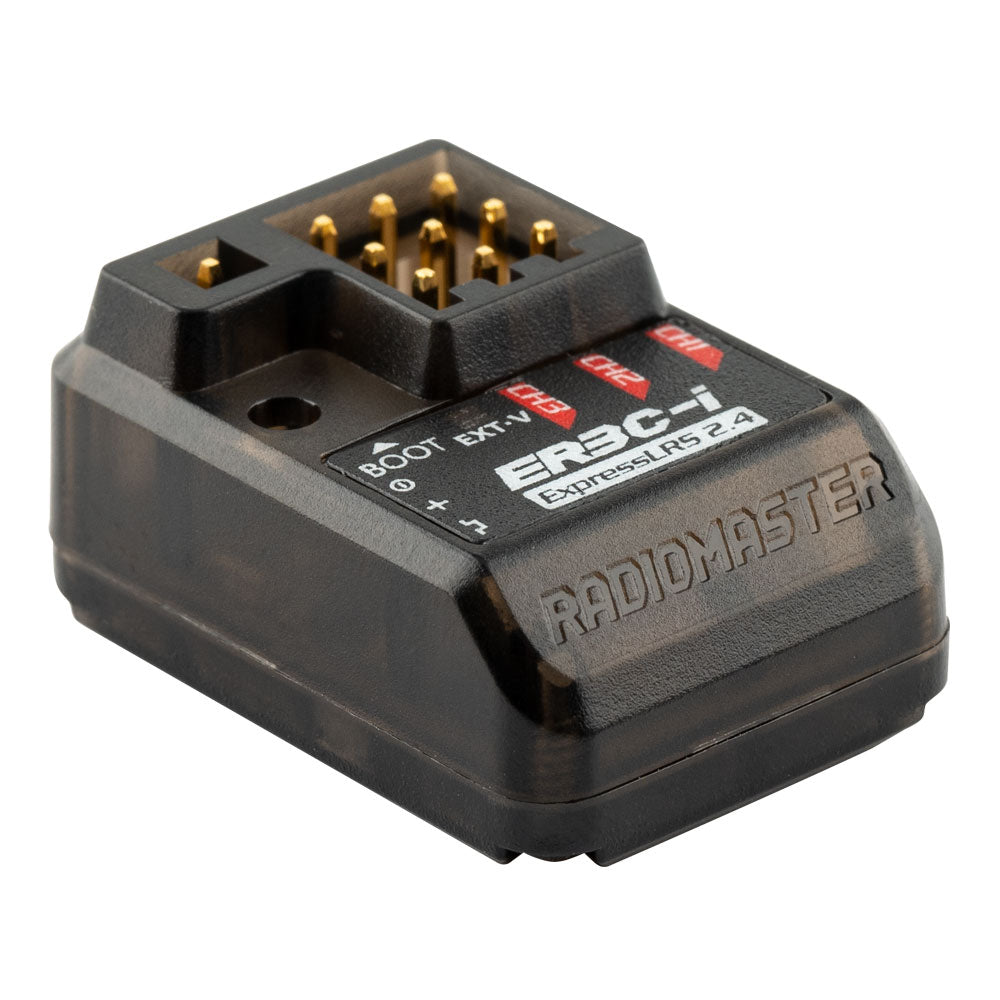
ELRS is a radio-link ecosystem, but it does not dictate how a receiver talks to the aircraft. A receiver with servo headers is useful for conventional airplanes, while a tiny serial receiver often suits a Betaflight multicopter. Buying by antenna count, ‘long range’ branding or price can leave you with an otherwise excellent receiver that simply has the wrong output interface. Here is how to separate radio compatibility from flight-control compatibility.
First identify what the flight controller expects
Most Betaflight FPV builds take receiver data over a serial protocol such as CRSF through a compatible UART. The receiver typically exposes power, ground, TX and RX pads. An airplane with ordinary servos may instead expect multiple discrete PWM channel signals; a PWM receiver offers conveniently labeled servo outputs. These are not substitutes without an appropriate controller or protocol conversion.
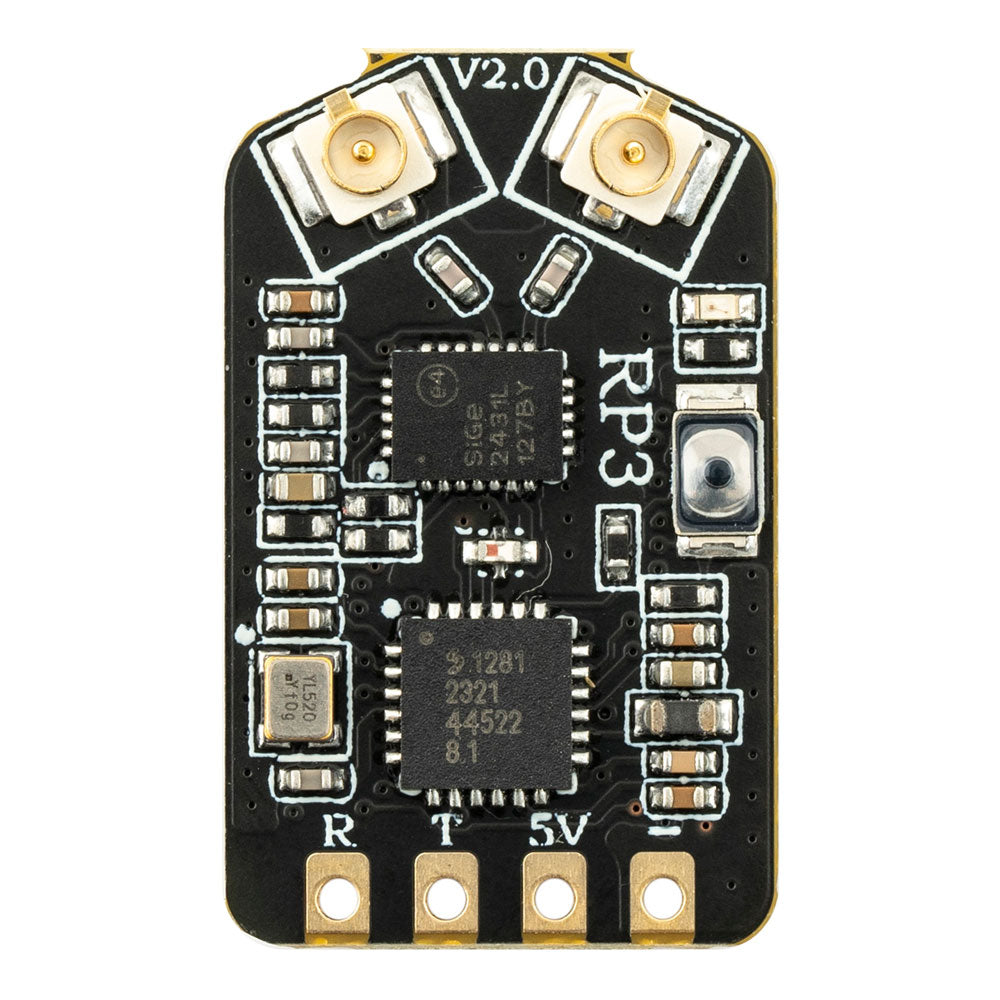
Two examples of these different receiver types are the RadioMaster ER8 PWM receiver and RadioMaster RP3 V2 serial receiver.
Read the aircraft’s flight-controller manual and pinout. Determine the supported serial UART voltage and wiring orientation before soldering. Receiver TX normally connects to FC RX and receiver RX to FC TX, but always use the product wiring diagram.
Compatibility has three layers
| Layer | Question | Common mistake |
|---|---|---|
| RF | Is transmitter and receiver on compatible ELRS bands and firmware? | Confusing 2.4 GHz with a sub-GHz receiver |
| Control output | Does the FC accept CRSF serial or discrete PWM? | Buying a PWM unit for a serial-only FC |
| Power/physical | Is the receiver power input and antenna mounting suitable? | Wrong voltage or crushed antenna coax |
Check all three layers on the exact model name, not a similar receiver sold under the same brand.
When a PWM receiver is the right purchase
For larger servo aircraft using RadioMaster’s dual-band Gemini-X PWM family, compare the 3-channel ER3 PRO, 12-channel ER12 and 16-channel ER16. These dual-band receivers require compatible ELRS firmware (RadioMaster specifies 4.1.0 or higher) and careful servo power planning; they are not automatically interchangeable with 2.4GHz-only PWM models.
For direct-servo output counts, compare the four-channel ER4, six-channel ER6G / ER6GV and eight-channel ER8G / ER8GV. Check the exact receiver’s pinout and supported serial configuration if you plan to use a flight-controller UART instead.
RadioMaster ER-series PWM products can be attractive for fixed-wing model aircraft where servos plug directly into separate channel ports. Channel count matters: count throttle, elevator, ailerons, rudder, landing gear and any auxiliary features before purchase. Servo power design matters too; never assume the receiver itself is a battery eliminator circuit capable of powering several large servos.
Make sure the radio’s model outputs map to the aircraft’s function assignments and test surfaces without a propeller installed. Observe direction and endpoints, especially for dual-aileron configurations.
When a serial nano receiver makes more sense
A compact serial CRSF example is the RadioMaster XR3 nano receiver. It supports selecting 2.4GHz or Sub-G RF operation with a suitable antenna package, but does not offer direct PWM servo outputs. Confirm the actual radio band, connector and ELRS firmware before choosing it instead of a PWM receiver.
For a compact multirotor, a small serial receiver reduces connector bulk and makes CRSF telemetry integration straightforward. The receiver still needs clean power, secure antenna placement and correct Betaflight port settings. Receiver diversity can improve reception in certain orientations, but only if antennas are installed properly and the transmitter supports the configuration.
Do not select a receiver on the promise of an advertised range. RF environment, antenna polarization and installation losses often dominate the real outcome.
Installation and bench validation
Mount antennas clear of carbon and high-current battery wiring where practical; avoid tight bends at the coax connector. Verify the receiver LED state, link quality and channel response without props. In Betaflight, enable Serial RX on the chosen UART and select the appropriate receiver protocol. In a fixed-wing controller, validate each servo port. Inspect failsafe behavior before the first authorised flight.
See binding troubleshooting if the radio will not connect, and failsafe test procedures for a more complete safety check.
What to ask before ordering
Tell the seller your radio’s ELRS band, target receiver firmware generation, flight-controller model, required servo-channel count and available mounting space. A concise photo of the FC wiring diagram is more useful than saying only “I have an ELRS radio.” For advanced aircraft, check whether telemetry sensors and PWM output rate features are supported on the particular unit.
Field checklist: before you commit
- Identify the exact product revision and verify electrical, mechanical and firmware compatibility.
- Check weight, fitment, included accessories and what is sold separately.
- Keep a safe baseline configuration and document any settings or hardware changes.
- Bench-test without propellers where electronics are involved; fly only in authorised locations.
- Stop testing if you observe overheating, unexpected movement or radio instability.
Wiring example: a serial multirotor receiver versus servo airplane
A typical serial receiver on a Betaflight flight controller uses four basic connections: a supported voltage rail, ground, receiver transmit to FC receive, and receiver receive to FC transmit. The FC then decodes a multi-channel protocol such as CRSF. A conventional PWM airplane installation is different: each servo commonly receives its own signal line, and the power architecture must handle servo current safely. Plugging a PWM receiver into a UART socket does not magically convert individual PWM outputs to a serial stream.
Do not judge wiring solely by a manufacturer’s color convention. Two product families can use the same connector shell with a different pin arrangement. Photograph the model name and verify the official pinout before ordering adapters or fitting plugs.
Telemetry, redundancy and real requirements
Ask which telemetry values the pilot actually needs. A multirotor typically benefits from receiver-to-FC link statistics integrated into the flight display; an airplane may need additional telemetry sensors or PWM channel assignments. Antenna diversity is useful only when receiver architecture and installation support it; two antennas laid together against the same carbon plate do not guarantee resilience. A large number of output channels should also be justified by real functions rather than purchased as a substitute for better link reliability.
Finally, confirm radio RF band and regulatory firmware domain. Some receiver product names resemble each other across 2.4 GHz and sub-GHz versions, and a physically fitting receiver is not necessarily capable of binding with the transmitter module already owned. Check the manufacturer specification before soldering or plugging anything into a live aircraft.
Frequently asked questions
Can a PWM receiver bind to the same ELRS radio as a serial receiver?
Potentially yes, if RF band, firmware compatibility and binding configuration match. Binding does not make their output protocols identical.
Is CRSF the same as ExpressLRS?
No. ExpressLRS describes the RF link ecosystem; CRSF is a common serial communication protocol used between receiver and flight controller.
Is a receiver with more servo outputs always better?
No. It can be larger and heavier than needed for a multirotor, while still not providing the serial interface your FC expects.
Shop and read further
Explore a related FalconFly product or buying guide and our complementary technical guide. Use product specifications and latest manufacturer manuals to confirm the exact version before purchase.
Note: Observations in this guide are conditional; performance depends on equipment configuration, firmware, environment, payload and correct installation.

















