


Dual-Channel FPV Chargers: How to Budget AC Power and Charge Current

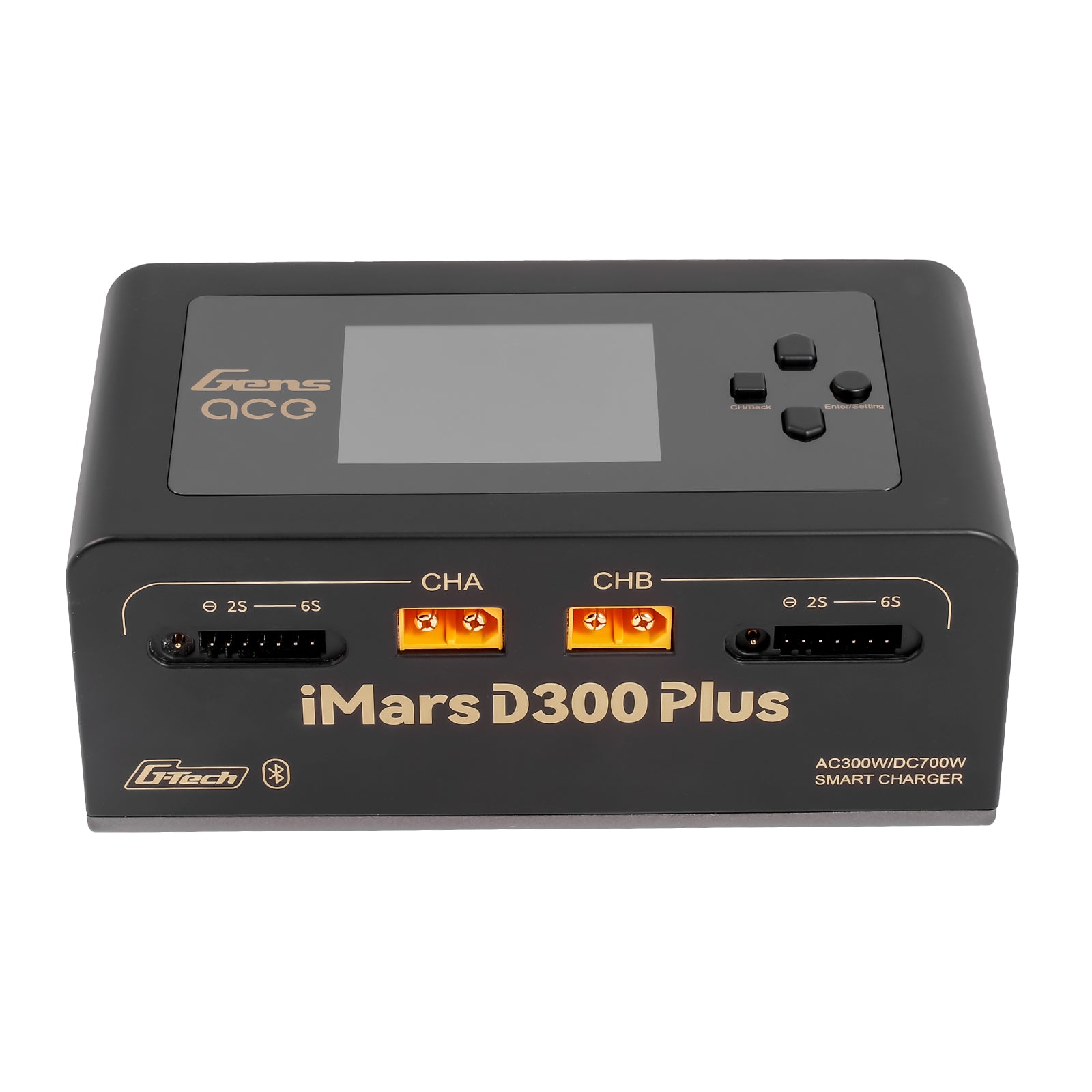
A dual-channel charger may advertise a high peak output number, yet the number available from an ordinary AC outlet can be substantially lower than its DC-input rating. Before ordering a charger such as the Gens Ace iMars D300 Plus, plan what two batteries require simultaneously, how output power is shared and whether the external power supply is included. The practical result is fewer interruptions and less pressure to charge at unnecessarily high current.
Watts, amps and volts: the essential relationship
Charging power is approximately terminal voltage multiplied by charge current. A 6S pack near full charge is about 25.2 V on a conventional LiPo setting. At 2 A that is roughly 50 W delivered to the pack, before internal charger losses. Two such batteries at that point would need about 100 W of charging output; a much higher charge current requires more power. These numbers are illustrative rather than fixed, because pack voltage rises during charging.
Why AC and DC ratings can differ
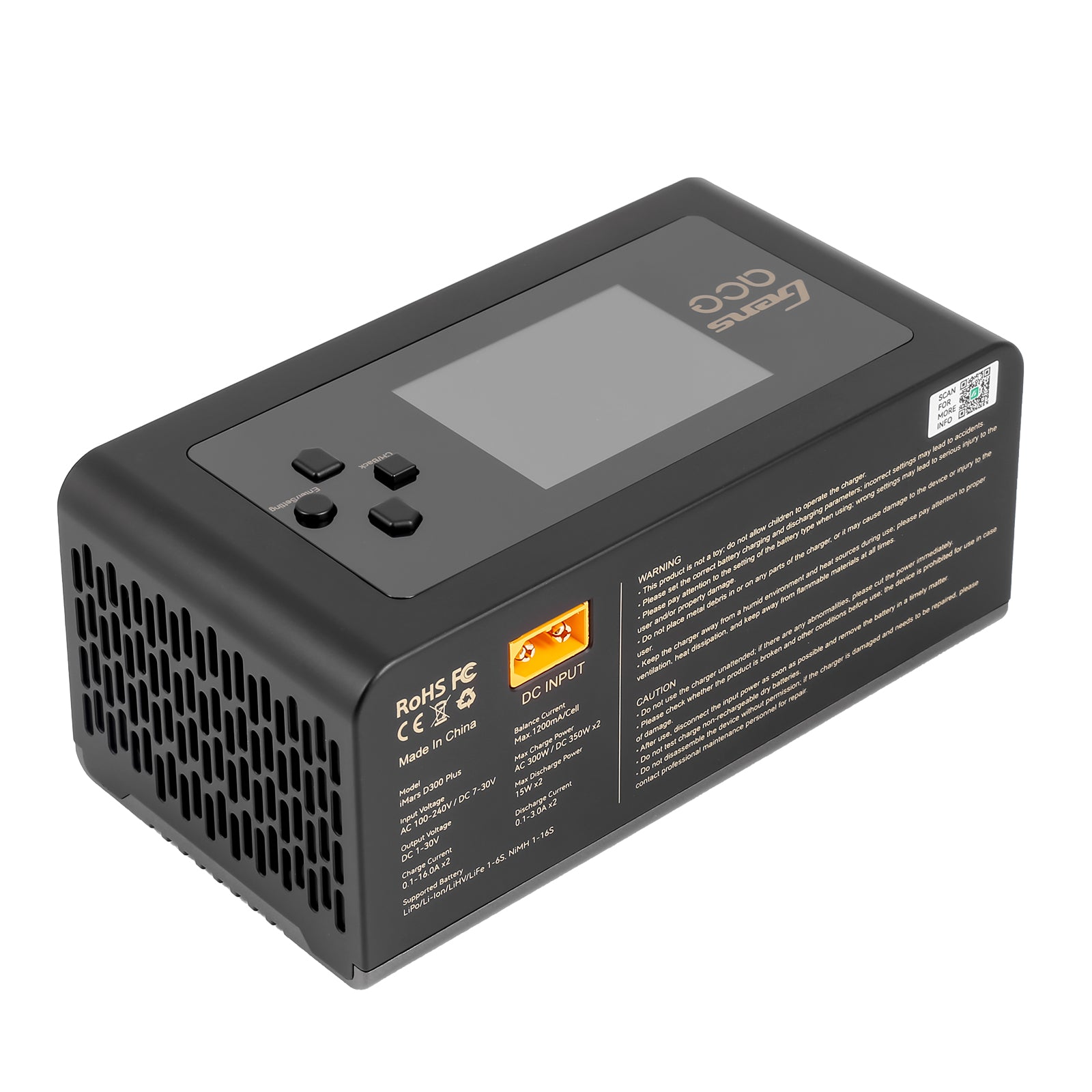
A dual-input charger may use an internal AC power supply with one total power limit and accept a higher-capacity external DC source. For the iMars D300 Plus listing, published mode-specific headline ratings should be checked against the current product manual; they are not interchangeable power promises. On DC input, a high charger power rating still requires a suitably rated external supply, connector and cabling.
Never infer that an AC mains outlet guarantees the full DC-mode rating.
A two-channel example
| Scenario | Estimated pack-side power near full charge |
|---|---|
| One 6S at 2 A | About 50 W |
| Two 6S at 2 A each | About 100 W total |
| Two 6S at 4 A each | About 200 W total |
The real AC input will be higher because of losses. Check each channel’s maximum current and the charger’s combined limit, not just the total printed on the product card.
Charge current and battery health
A charging rate of 1C means a current in amperes equal to the battery capacity in amp-hours: 1.6 A for a 1600 mAh pack. This is not a recommendation that every battery should be charged at 1C; follow the exact pack manufacturer’s charge limits and consider battery age. Faster charging may increase heat and requires compatible hardware. Always balance-charge multi-cell packs when directed.
Bench layout and safety
Keep battery packs on a nonflammable surface away from combustibles, with suitable fire precautions and constant supervision. Ensure fans and ventilation grilles are unobstructed. Route balance wires away from hot parts and avoid stacking batteries against each other. Use only appropriately rated input cables and manufacturer-supported adapters.
What to put in your shopping cart
Confirm AC cable region, external DC input specification, balance adapter type, included charge leads and the pack connectors you own. For Dubai customers operating at locations with frequent trips between the workshop and field, consider a charger that works conveniently from the available input source rather than a larger rating never used. Compare the charger selection framework and 6S capacity selection.
Checklist before purchase or repair
- Confirm the exact hardware model, revision and manufacturer instructions.
- Check rated operating voltage, physical fit and connection compatibility.
- Inspect equipment for damage; do not bypass protective charging or safety systems.
- Record symptoms and configuration changes rather than guessing.
- Use an authorised flying area and a conservative field test only after successful inspection.
Worked example: estimating channel limits
A dual-channel charger delivering 120 W to one battery and 80 W to another would be providing 200 W total output. If the internal AC supply is limited below that demand, the charger must reduce one or both channel currents or refuse a setting. Likewise, if a DC supply has insufficient wattage, a charger rated for a high DC input cannot create the missing power. Account for efficiency losses and leave a reasonable power margin when selecting an external supply.
At the pack level, calculate expected peak charge power using the highest normal cell voltage, not nominal voltage alone. For a conventional 6S pack, use approximately 25.2 V near full charge. Multiply by proposed charge current to estimate the requirement for each channel, then compare the combined demand with the manufacturer’s specified limits.
Choosing between one large channel and two moderate channels
For a pilot with two batteries and ample turnaround time, moderate charging on both channels may be more useful than maximum current to a single pack. The choice changes for field operations where only one pack needs immediate replacement. Charging speed should never take precedence over battery health, temperature limits or manufacturer-recommended charge rates.
When buying a power supply, confirm connector polarity, allowed input-voltage window, rated continuous output and cooling. Do not combine unofficial high-current adapters merely to achieve a headline wattage. A complete charging setup includes safe cables, a reliable mains or DC supply, suitable battery leads and adequate supervision—not only the charger box.
Frequently asked questions
Can two channels both run at maximum current?
Not necessarily. The shared AC/DC power budget and per-channel current limit determine what is achievable.
Does a charger labeled 700 W draw 700 W from a home socket?
Not automatically. Many chargers offer different maxima in AC and external DC modes; verify the manual.
Do I need an external DC supply?
Only if your charging plan requires a DC-input mode not covered by the built-in AC supply. Match voltage and power ratings.

















