FPV Flight Controllers and ESC Stacks: What Must Match Before You Build

A flight controller and ESC stack can look compatible on paper and still be a difficult installation. The mounting holes may fit while the connector pinout does not, or the ESC may accept the battery but the video system may not. A few checks made before assembly prevent most of those problems.
Separate what the FC and ESC actually do
The flight controller runs the flight software, reads sensors, processes pilot inputs and generates motor commands. The electronic speed controller delivers power to the motors. A 4-in-1 ESC combines four ESC channels on one board; a stack is an FC and ESC commonly packaged together. Neither guarantees that a receiver or video transmitter has the right electrical interface.
Look for supported flight firmware, board target, gyro/sensor design and adequate UARTs on the FC. On the ESC, consider supported battery cell count, continuous current rating, cooling and physical dimensions. High current numbers are only meaningful when evaluated under the manufacturer’s test assumptions.
Mechanical fit and harness pinout
Check stack mounting pattern and height: 20×20 mm and 30.5×30.5 mm systems are not automatically interchangeable. Frame standoffs, soft mounting hardware, air-flow space and USB port access all matter. Even within the same manufacturer, an FC-to-ESC harness may use different pin assignments; do not mix harnesses by appearance.
Before powering on, compare each pin against the schematic of both boards: battery voltage, regulated supply, ground, current sensor and motor signal lines. Reversing power or ground can destroy electronics. A current-limited smoke stopper can help during initial bench testing but cannot replace a careful wiring inspection.
Power planning for a complete build
An ESC specified for 6S operation may coexist with a camera that cannot tolerate direct 6S voltage. The standard DJI O4 Air Unit, for example, has a lower input range than O4 Pro. Work out where your regulated rails originate and which components draw from them. Receiver, GPS, buzzer, LEDs and video equipment also need appropriate supplies.
Estimate total current and heat realistically. Tight stacks in ducted cinewhoops may see less airflow than a spacious freestyle build. Give wires strain relief and protect sensitive connections from prop strikes.
Bench checks before the first flight
Remove propellers before flashing firmware, assigning motor direction or checking receiver response. Verify the FC target, orientation, receiver UART and protocol, motor mapping, ESC firmware and failsafe in sequence. Check that the OSD reports useful information, and confirm radio switches do not activate unexpected outputs.
A functioning motor test is not proof that a build is flight-ready. Vibration, incorrect props, unreliable connections or improperly configured failsafe still matter. Follow the specific flight controller manufacturer’s commissioning checklist.
Components to examine
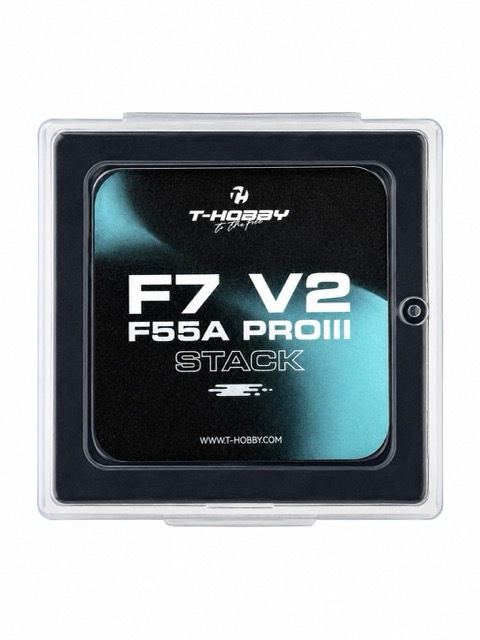
FalconFly lists the T-HOBBY F7 V2 + F55A Pro III Stack as one integrated option and the T-HOBBY V70A / Velox F7 Stack for another voltage class. These are not interchangeable recommendations: compare mounting, current, motor, battery and video-system requirements against your exact aircraft.
Questions worth asking before purchase
Can I plug any 4-in-1 ESC into any FC?
No. Mechanical standards and connector shape do not guarantee matching harness pinouts or signal requirements.
Will an ESC rated for 6S power a standard DJI O4 Air Unit?
Only if the Air Unit receives a properly rated regulated supply; the battery input voltage may be too high for the standard unit.
Do all F7 flight controllers support the same receivers?
No. Check available UARTs, firmware target and serial receiver protocol configuration.
Do higher current ESC ratings improve flight automatically?
No. They provide potential current handling; motors, props, wiring, cooling and tune determine performance.
Why does my motor spin backwards?
Confirm motor direction and prop orientation according to flight software and ESC configuration; never test with propellers installed.
Explore the FalconFly FPV Knowledge Hub for related technical buying guides. Specifications and compatibility should be verified for each exact model.
Further reading: DJI Air Unit documentation · Motor/prop matching discussion