


1kWh vs 2kWh Power Station for Drone Crews: Calculate Real Field Charges

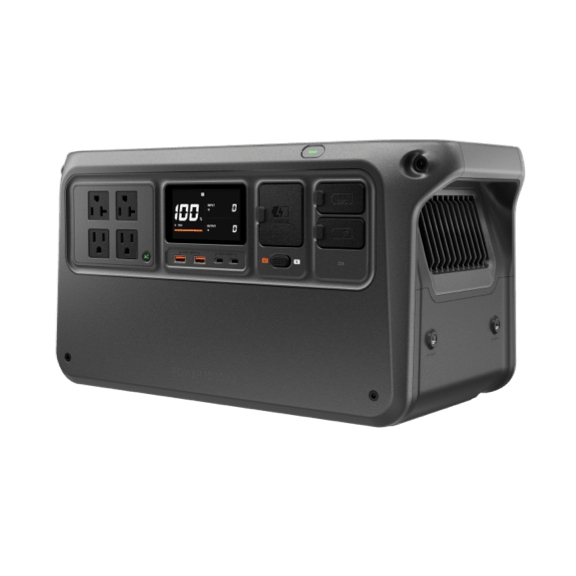
For drone teams, a 1,000Wh versus 2,000Wh label is only half the decision. The number of useful charging cycles depends on the energy actually replaced in the aircraft packs, conversion losses and simultaneous charger limits.
Separate station energy from charger power demand
A 1kWh or 2kWh station choice begins with two different units: watt-hours of usable energy and watts of simultaneous charger demand. A crew with two charging hubs can run out of output capacity even while plenty of stored energy remains.
| What you notice | What to investigate |
|---|---|
| Two hubs together trip an output limit | Station port or inverter limit may be exceeded |
| Fewer battery charges than expected | Charging losses and reserve capacity are real |
| Unit adequate in lab but not in hot field | Thermal derating and conditions may affect use |
Diagnosis map
1. Convert requirements into Wh
Find the manufacturer energy rating for each aircraft battery. A nominal 100Wh pack charged from 20% to 90% needs about 70Wh stored in cells, plus charger conversion losses.
2. Estimate losses with a range
Do not promise an exact charge count from capacity divided by battery nameplate. Allow for inverter, hub and battery inefficiencies and the usable discharge window.
3. Check simultaneous watts
Two fast chargers and a survey receiver may run at the same time only if all AC/DC outlet ratings, combined limits and charger input modes allow it.
4. Compare portability
For a walking field crew, total mass, carry handles, temperature range and recharge logistics may matter more than doubling capacity.
5. Match charging interfaces
Check USB-C PD profiles, DJI SDC cables, AC sockets and firmware. A port advertised at a high wattage cannot power an incompatible hub at that rate.
Practical technical analysis, examples and decisions
Wh and W answer different questions
Watt-hours describe stored nominal energy, while watts describe how quickly a port can deliver power. A station advertised as 1024Wh may run an 800W appliance if its inverter and outlet ratings support that load, but not necessarily for 1024/800 hours after conversion losses. Likewise a 2000Wh unit is not useful for simultaneously running two high-power charging hubs if its individual port, inverter or combined output limit is too low. Read the exact port table before buying, especially when a DJI charging hub advertises more than one charging mode. Capacity and instantaneous output are separate purchasing decisions for a drone field crew.
Example: partial charging rather than full cycles
Suppose a fictional battery stores 100Wh when full and you recharge it from 20% to 90%. The ideal cell-energy increment is approximately 70Wh, not 100Wh. If the charging chain from station to battery were 80% efficient under those conditions, it might draw about 87.5Wh from the source to accomplish that increment. Ten identical partial charges would therefore require roughly 875Wh before allowing for station reserve and other equipment. Actual results depend on charger efficiency, temperature, battery condition and charging profile. This arithmetic is a planning estimate, never an exact performance promise for a specific DJI battery model.
Compare inverter and DC routes
A battery hub powered via AC may cause station DC-to-AC conversion, followed by AC-to-DC conversion inside the charger. A manufacturer-supported direct DC connection may avoid one stage, but only if voltages, cables, negotiated profiles and power limits are compatible. A USB-C socket rated for high wattage may not supply the required voltage profile for a particular drone battery hub. DJI SDC is a specific connection family, not a generic USB-C synonym. Look up the official adapter part number and supported power station before plugging anything in. A wrong cable can make charging slow or impossible even when the nominal watt ratings look sufficient.
Two hubs plus RTK accessories
A survey crew might want to power two drone charging hubs, an RTK reference receiver and a small laptop at the same time. Create a table of each device’s maximum input watts and input voltage, and compare it with both the station’s total output and per-port limits. Sum the worst-case simultaneous demands rather than assuming every device draws its average energy divided by time. Fast charging can raise demand near certain battery charge levels. Some power stations automatically derate or shut outputs in high heat, and station fan noise or socket placement may affect field operation. Carry safe approved extension and cable arrangements when the manufacturer’s instructions permit them.
Temperature and transport change the answer
A crew on foot may prefer a smaller 1kWh-class unit that can be carried safely, while a vehicle-supported film team may accept 2kWh or more for longer work. Weight and dimensions matter alongside energy. Check the device’s charging and discharge temperature ranges and do not leave lithium power stations in direct sun or enclosed cars during UAE summer. If planning air travel, large stations may exceed airline battery restrictions; verify exact Wh and relevant regulations instead of assuming ‘portable’ means cabin-safe. A field charging plan also needs a way to replenish the station between days. The best capacity may be the one that fits the mission logistics rather than the largest unit available.
How to make a credible vendor comparison
Compare specific models on nominal Wh, usable output energy, sustained AC output, DC ports and supported DJI charging interfaces, weight, ambient operating limits and warranty. Test realistic charging with representative packs if possible and record the starting and ending station percentage. Include safety reserve for the RTK unit and mission-critical communications rather than using all energy for batteries. Some customers need high peak power for a short shoot; others need low-power continuous support over many hours. Ask which devices must run concurrently and for how long. Do not advertise a fixed number of Mavic or Matrice charges without specifying initial and target state of charge, charger and weather.
Deeper troubleshooting and practical decisions
Translate the station nameplate into aircraft battery energy
Portable stations advertise stored energy in watt-hours, whereas charger output ports are specified in watts. They answer different questions. A 1,024 Wh station has a nominal energy capacity of 1,024 Wh, but usable energy available to a specific charger will be reduced by conversion and internal reserve. Suppose a drone battery is rated at 100 Wh and must be replenished from 20% to 90%. The ideal energy returned to the cell is roughly 70 Wh before conversion losses. Dividing 1,024 by 70 gives an unrealistically optimistic upper bound if treated as exact charge count. For planning, multiply by a measured or conservatively estimated overall efficiency rather than promising a number from the brochure.
Worked field example: six batteries, two hubs
Imagine a crew with six identical 100 Wh batteries, each arriving at 20% and returning to 90%. The ideal energy replenishment is six times 70 Wh, or 420 Wh stored in cells. If the total station-to-battery efficiency for that particular equipment and usage were 80%, the station would need approximately 525 Wh. An efficiency assumption is not a laboratory measurement: actual losses depend on AC inverter operation, hub power consumption, battery temperature and charging rate. A 1 kWh unit may therefore cover this session under those assumptions, leaving reserve for further charging or controllers. A 2 kWh unit offers more capacity, but the working time still depends on charge scheduling.
Power ports are not interchangeable
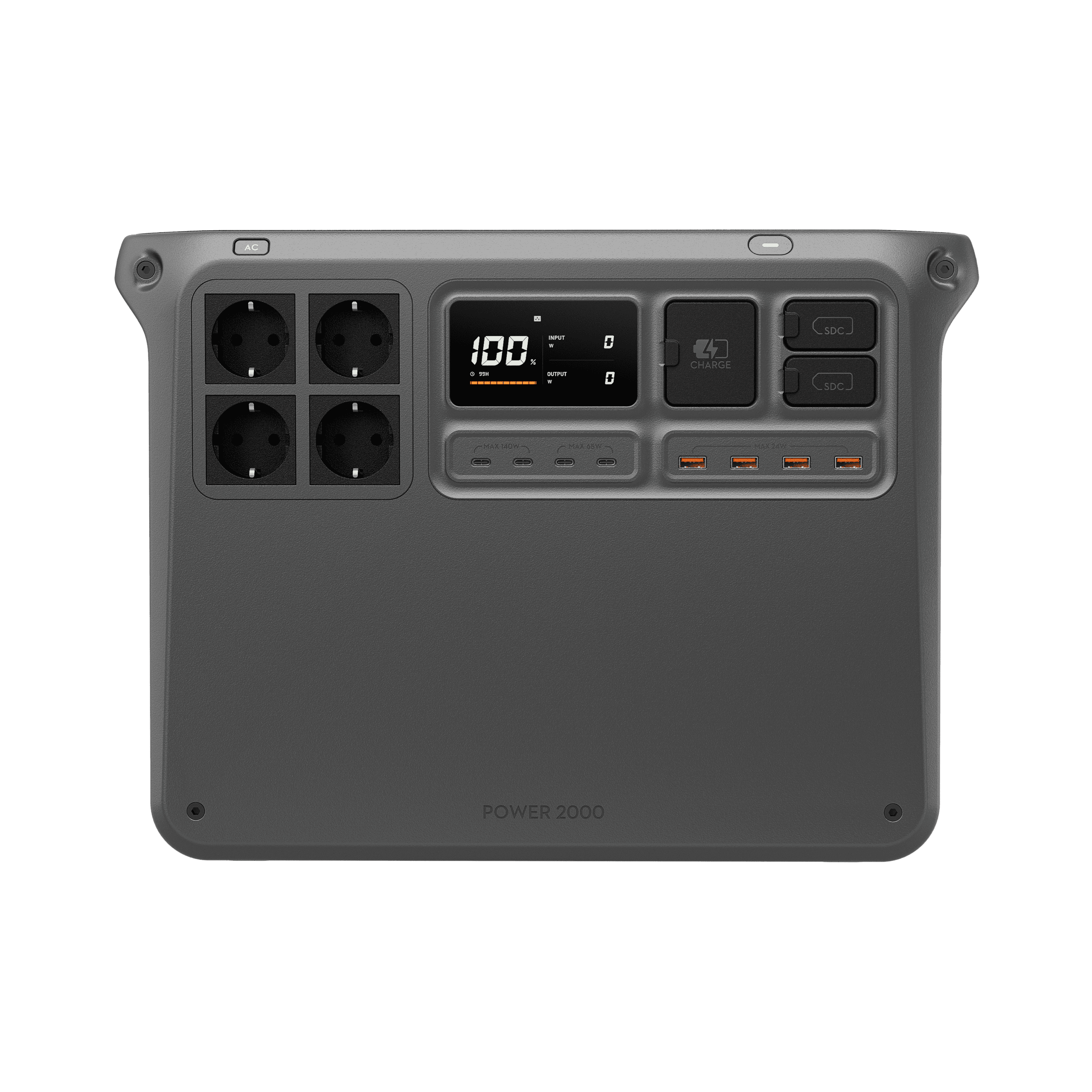
A 140 W USB-C port, a 230 V AC outlet and a proprietary DJI SDC output are different electrical interfaces. A charging hub may accept a particular USB-C Power Delivery profile, require a specific SDC cable or use an AC adapter with its own current limit. Adding two 140 W ports together does not mean a single connected device can draw 280 W. The station may impose combined output limits, and a charger may split available input power between its slots. Check both the station’s individual and total output ratings, plus the hub’s actual input specifications, before promising simultaneous service to multiple drones. A connector fitting physically is not sufficient evidence of protocol compatibility.
The 1kWh versus 2kWh weight trade-off
The DJI Power 1000 V2 is advertised as a 1,024 Wh LFP unit weighing approximately 14.2 kg, whereas DJI Power 2000 is a 2,048 Wh product weighing approximately 22 kg according to DJI’s comparison. Those values illustrate why the larger unit is attractive when travelling by car and less attractive for a field team carrying equipment on foot. Consider how batteries, controller case, survey gear and the station itself are transported. Charging speed from a vehicle, access to AC between sites, protected cable routing and local solar conditions can dominate the day’s practical throughput. A larger energy store is not always the most economical way to reduce downtime.
Hot-weather losses and safety margin
High ambient temperature can cause a station, AC inverter, adapter or aircraft battery to limit its power to protect the cells. Do not extrapolate lab maximum output to a sealed SUV cargo compartment on a hot day. Provide manufacturer-compliant airflow and shade while avoiding moisture and dust intrusion, and keep AC adapters and battery packs off flammable surfaces. Reserve power for essential communications and positioning equipment rather than planning the last Wh for another optional camera battery. Test the complete charging chain under representative conditions before a professional mission. Actual energy used per pack can be read from a station display or inline meter when supported.
How to choose and document a field-power setup
Build a load table with every pack’s Wh rating, start and target state of charge, the number of daily replenishments, charger input type, maximum simultaneous input watts, station usable capacity estimate and transportation constraints. Add a line for equipment that runs continuously, such as survey receivers or laptops. If the total exceeds comfortable reserve, plan staggered charging, vehicle recharging or a larger unit. Do not recommend an expansion battery until verified compatible with the exact station model. For DJI Power 1000 V2 and DJI Power 2000, confirm current specifications and allowed accessories from DJI before ordering, since product generations and connection systems differ.
Repair, upgrade, or keep the existing equipment?
Choose additional station capacity only after calculating required Wh, outlet limits and transport constraints. A more expensive part is not automatically the correct fix. Explore the related FalconFly UAV product category for equipment that matches the verified requirement.
Realistic workshop and field scenarios
Case 1: A 1kWh station charges fewer batteries than simple division predicts
Nominal power-station capacity is stored energy, not a promise of equal energy reaching every drone cell. Inverter, charger and battery losses reduce delivered Wh, and many stations have an operational reserve. Calculate from the energy actually added to each pack, not only its maximum nameplate value. If a 100Wh pack moves from 20% to 90%, the ideal cell energy added is around 70Wh before losses. Test the actual charging chain in representative conditions where practical. A vague statement such as ‘twelve batteries per station’ is meaningless without initial state of charge, the charger used and the particular battery model.
Case 2: Two charging hubs are fast individually but trip a shared output
Check both individual port ratings and the station’s combined AC/DC output limit. Each hub may request considerable power during part of the charging process, and a laptop or RTK receiver adds additional load. Sum the expected peak concurrent inputs rather than average energy divided by session duration. A unit can store abundant energy but lack the correct voltage profile or socket to deliver it quickly. Manufacturer cables for DJI SDC and USB-C are not universal substitutes. A stable field setup uses known approved cable paths, adequate cooling and a power budget that preserves reserve for essential monitoring equipment.
Case 3: The crew chooses between transporting 1kWh and 2kWh
Doubling energy often means significant additional mass and volume, which can be inconvenient for a walking inspection team. Check rated handle ergonomics, operating temperature and travel restrictions alongside Wh. A vehicle crew conducting extended shoots may reasonably prefer a larger station or extra compatible expansion modules, but only when those modules are officially supported by the specific base model. The label ‘Power 1000’ across product generations does not imply expansion-port compatibility. Compare the real model numbers and specifications. For sites with reliable grid access, a smaller fast-recharge station may be more practical than carrying the largest possible unit all day.
Case 4: A station works indoors but derates under the Dubai sun
Power stations, drone battery chargers and aircraft packs each have their own charging and discharge temperature limits. High ambient heat, poor ventilation or direct sun may reduce available output or prevent charging. Test within documented ranges and provide shaded, ventilated placement that does not trap exhaust heat. Do not promise the maximum lab output under every summer condition. A responsible estimate includes charging downtime and reserve power for safety-critical devices. If the customer needs five uninterrupted hours of RTK equipment operation, continuous power stability can matter more than the number of drone packs that can theoretically be charged.
Frequently asked questions
Will 2kWh always give exactly twice the flights?
No. It has roughly double nominal energy, while usable charge cycles depend on conversion, operating limits and pack state.
Can I leave a station in direct sun during charging?
Follow the station’s and charger’s ambient operating limits; provide safe shade and ventilation.
Final quality and safety check
Confirm the station’s actual simultaneous port limits and the connected chargers’ input profiles before promising a number of field charge cycles. Leave energy reserve for flight-critical equipment, and provide shade and ventilation within the manufacturer’s temperature limits.
Product announcement dates: DJI introduced Power 2000 globally on 2 July 2025; the DJI Europe release announcing Power 1000 V2 is dated 9 July 2025. The WordPress editorial date is set to 23 July 2025, fourteen days after the later global announcement; this guide was last technically reviewed in November 2026.
Primary technical reference
DJI Power 1000 V2 official product specifications. Charging interfaces and expansion-battery support vary across DJI Power generations.

















