FPV Antenna Compatibility: RHCP, LHCP, SMA and U.FL Explained

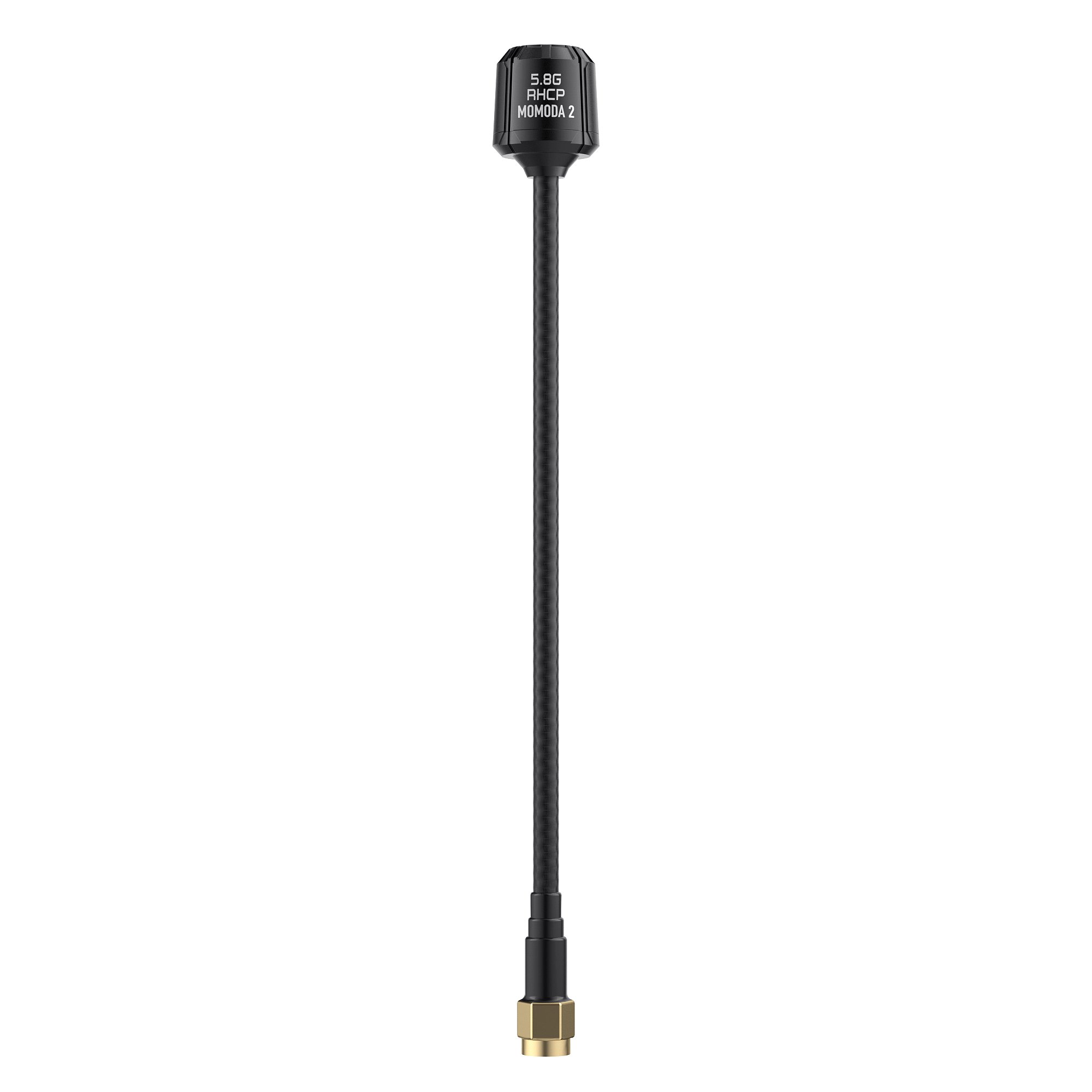
When an FPV video link breaks up, antenna shopping often becomes a search for the largest printed gain number. In practice, polarisation, frequency, connector, cable condition and placement are more likely to explain a poor link than the brand of a replacement antenna. The useful purchase is the one that correctly matches the system already on your bench.
Begin with frequency: 5.8 GHz video is not 2.4 GHz control
Most traditional analog FPV video transmitters use the 5.8GHz band, while an ExpressLRS radio might use 2.4GHz or an 868/900/915MHz variant. An antenna designed for one band must not be selected for the other on the basis that both products say ‘FPV’. Read the RF device’s supported range and the antenna’s actual frequency specifications. An advertised multiband antenna only helps when its documented bands cover the hardware it is connected to.
For example, FalconFly lists a GEPRC Momoda2 5.8GHz RHCP SMA video antenna and a GEPRC Tri-Band Stick Antenna for different RF-band needs. They should not be treated as direct alternatives simply because both connect to drone equipment.
RHCP and LHCP should not be mixed casually
Circular polarisation describes the rotation of the electromagnetic field. Right-hand circular (RHCP) and left-hand circular (LHCP) antennas are not interchangeable as matched links: a mismatched pair can incur a substantial signal penalty. Before replacing only the air-side antenna, identify the polarisation of the antennas on your goggles or receiver. Match RHCP to RHCP or LHCP to LHCP unless the equipment’s documentation specifies another arrangement.
Linear antennas bring another set of trade-offs. Mixing linear and circular polarisation can still produce a link, but not with the same performance as a properly matched pair. For small whoops with constrained weight, different compromises may be reasonable than for a larger 5-inch or long-range airframe.
SMA versus RP-SMA versus U.FL
An SMA connector and RP-SMA connector can look almost identical until you inspect the centre pin/socket arrangement. RP-SMA reverses that arrangement; forcing a mismatch or installing a mechanically similar but incorrectly mated adapter is not a solution. Neither SMA nor RP-SMA is inherently higher-quality RF because of its name. Match the specified connector gender and polarity for the actual device.
U.FL is a much smaller snap-on connector often seen inside compact video systems; it is not designed for unlimited connect/disconnect cycles or for carrying the load of a rigid external antenna without strain relief. The GEPRC Peano 5.8GHz RHCP U.FL illustrates that class. Check the cable routing and whether the frame includes a secure antenna mount. A damaged micro-coax lead is easy to overlook after a crash.
High gain is not a universal upgrade
A high-gain directional antenna concentrates sensitivity in particular directions; it may work well on a ground receiver pointed at an operating area but be unsuitable for an aircraft that constantly rolls and yaws. A practical diversity goggle arrangement can combine an omnidirectional antenna with a directional one when supported by the receiving hardware. If you mostly fly close freestyle, consistent coverage may matter more than long-distance peak gain.
Mount antennas away from carbon, high-current wiring and metalwork where practicable. Maintain a path for bending and impacts, and consider how much antenna can protrude from a frame without hitting the ground. No antenna can turn an unsupported VTX frequency or illegal RF configuration into a compliant operation.
A disciplined approach to poor video reception
Separate the symptoms: a link that works until the drone turns around points towards antenna orientation or shielding; sudden failure after a crash points towards connectors and coax; a permanently blank image may be camera or video-input failure rather than poor RF reception. Our FPV black-screen and OSD troubleshooting guide provides a step-by-step diagnostic path. Inspect the transmitting antenna before powering a high-power analog VTX; some units may be damaged if they transmit into an open or unsuitable RF load.
undefined
Frequently asked questions
Does RHCP work with LHCP?
The link may exist but suffers a strong polarisation mismatch. Match circular polarisation at both ends unless using a supported special configuration.
Is RP-SMA the same as SMA?
No. The centre pin/socket arrangement differs. Inspect both device and antenna connectors rather than judging from the outer thread alone.
Can I use a 2.4GHz antenna on a 5.8GHz VTX?
Not unless the manufacturer specifically rates it for both bands. Frequency mismatch can cause severe performance problems.
Are longer antenna cables always better?
No. Cable loss and physical vulnerability can outweigh a placement improvement. Select suitable length and quality for the mount.
Should an FPV drone use a directional antenna?
Usually a robust omnidirectional transmitter antenna is preferable on manoeuvring aircraft; directionality can be valuable at the supported receiver.
Why did my video range deteriorate after a crash?
Inspect the active antenna, U.FL or SMA connector, coax, mounting and VTX before changing RF power settings.
Can antenna gain override UAE transmission regulations?
No. RF output and drone operation must follow current applicable rules regardless of antenna selection.
Explore other FalconFly buying guides or compare product specifications in our store.
Technical references: Oscar Liang FPV antenna guide · Antenna connector reference