


ND, UV and Polarizing Filters for DJI O4 Pro: What Actually Helps?

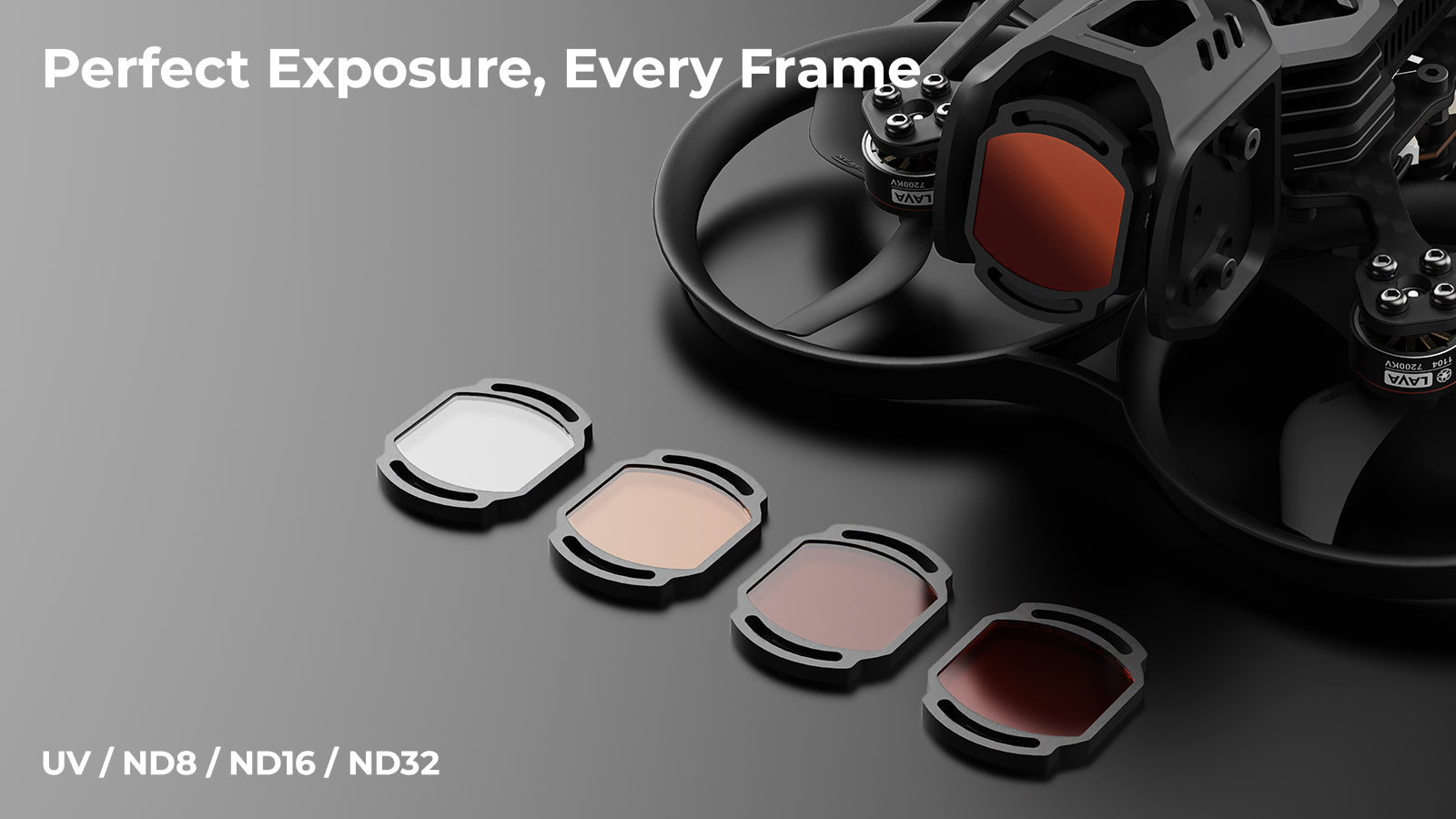
Digital FPV pilots often buy an ND filter expecting richer colors or automatically smoother video, then discover the exposure, motion blur or lens mount still needs attention. Neutral-density, UV/protective and polarizing filters solve different optical problems. On a compact DJI O4 Pro camera, added glass can also affect fitment and physical protection. This guide explains when each filter is useful, how it affects shutter strategy and what to verify before ordering a model-specific set.
Know what each filter does
| Filter | Primary effect | Trade-off |
|---|---|---|
| ND | Reduces incoming light without intentionally changing color | Can force higher ISO in dim scenes |
| UV/protector | Mainly physical protection in modern digital use | Extra glass and potential glare |
| CPL | Can reduce certain reflections and deepen some skies | Depends strongly on camera angle to the sun |
Why ND matters for FPV motion blur
Cinematic motion-blur conventions often target a shutter time near twice the frame rate denominator—roughly 1/50 second at 25 fps or 1/60 at 30 fps. This is a creative guideline, not a hard rule, and actual flicker management and exposure differ by lighting. In bright UAE daylight, an ND filter may be needed to maintain a slower shutter without clipping highlights at the selected ISO and aperture.
A stronger filter is not better by default. Excess ND can force noisy ISO or underexposure when you fly from sunlight into shade.
Drone-specific physical compatibility
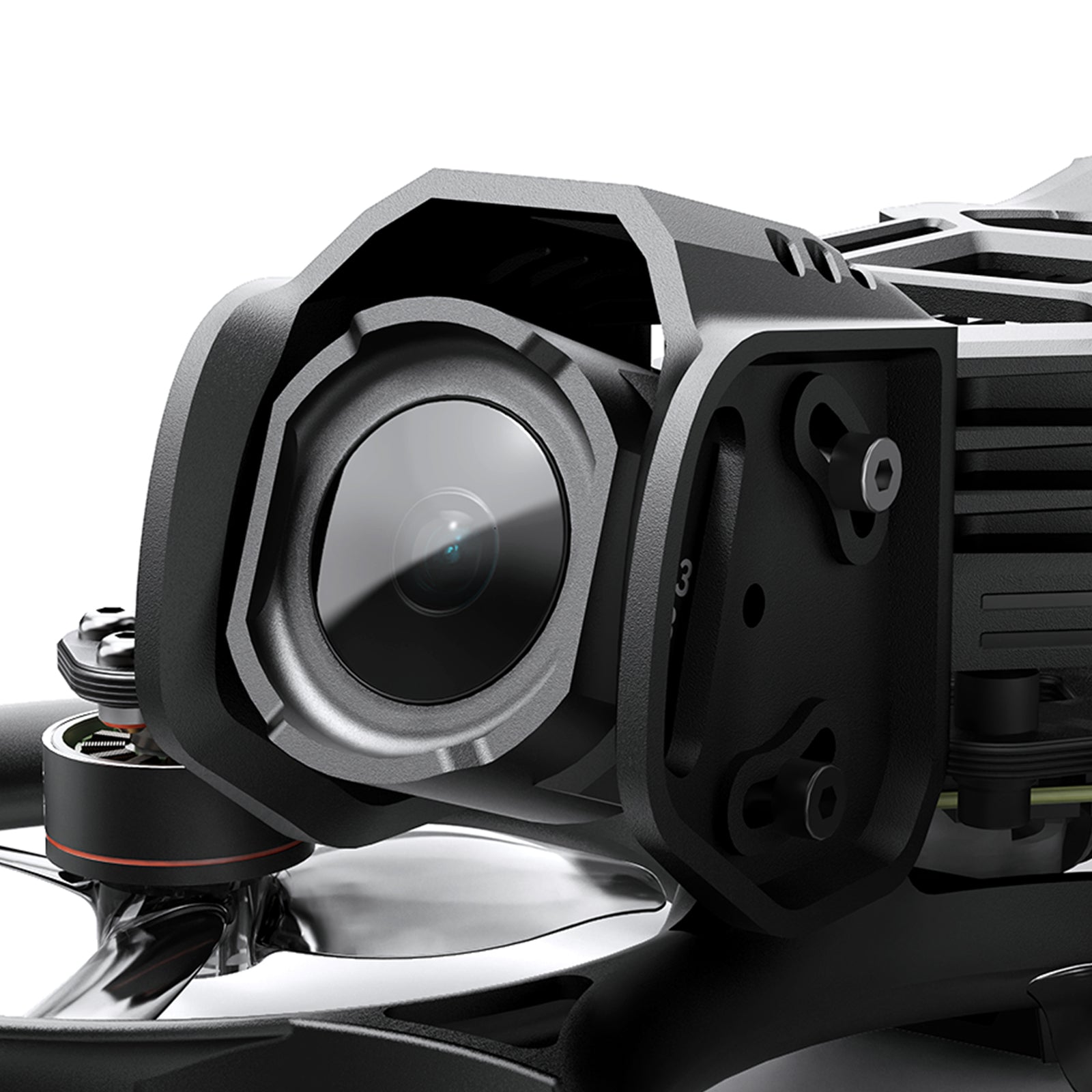
Confirm the filter design supports the exact O4 Pro lens and camera housing. Check mechanical attachment, clearance to the canopy and whether any mount or duct edge interferes as the camera tilts. A filter sold for another action camera or an older DJI air unit may be visually similar but physically wrong. Do not force a press-fit filter or rotate the lens assembly to install it.
The sunlight test
Begin with a clean lens, locked frame rate and your intended picture profile. Set the shutter strategy for the desired look, then add only enough ND to hold exposure without excessive ISO. Inspect a short real-world clip for blur, highlight clipping, flare and color casts. Repeat in shaded conditions if your flight route contains dramatic light transitions.
Why polarization can be tricky in flight
Polarizers produce different effects as aircraft heading and angle to the sun change. A perfectly darkened sky in one direction may become uneven during a turn, particularly with wide lenses. Reflections can also change rapidly. Do not expect a CPL to replace carefully managed exposure or solve direct propeller-shadow flicker.
Practical maintenance and buying priorities
Clean glass with suitable optics tools and inspect for chips after landings. Carry a secure case; loose filters are easy to scratch. For low light, remove unnecessary ND. For aggressive FPV, verify that the mount cannot detach into the propellers. See O4 Pro system differences and cinematic drone selection before investing in accessories.
Safety and ordering checklist
- Verify the exact model, revision and rated installation conditions.
- Document the original setup before making any configuration change.
- Keep propellers off during electronic or motor bench diagnostics.
- Do not ignore unusual heat, smoke, intermittent control or physical damage.
- Fly only when the aircraft is fully checked and local flight authorization permits it.
Exposure example: a bright afternoon shot
Suppose the camera is recording at 30 fps and the operator wants the familiar cinematic motion-blur look around 1/60 second. In bright daylight, that shutter may admit too much light even at the lowest usable ISO. A neutral-density filter reduces illumination so the desired shutter can be retained. If a strong ND filter is left fitted during a shaded pass, the camera may raise ISO or underexpose instead. That is why most experienced operators carry multiple strengths rather than selecting the darkest filter permanently.
For fast freestyle moves, a shorter shutter can make individual video frames clearer and may improve perceived detail at the expense of natural blur. This can be a deliberate creative choice. There is no universal shutter setting that makes every FPV sequence cinematic.
Lens accessories and image reliability
Each extra optical surface can add reflections or flare, especially when shooting toward strong sunlight. Check the coating quality and whether the filter introduces softness around the edges of a wide-angle lens. A polarizer that darkens one direction of sky can create dramatic changes when the drone rotates. Review footage during realistic camera movements, not only with the aircraft stationary on a table.
Before a shoot, clean the filter, confirm secure mounting and inspect the propeller and canopy clearance at every intended camera tilt angle. Carry protective storage so the filter does not scratch other equipment. If the lens protector itself is damaged, replace it with the correct part rather than stacking filters in an improvised arrangement.
Frequently asked questions
Does ND improve sharpness?
Not inherently. It reduces light and can enable a chosen shutter speed; too much ND may make footage noisier.
Can a UV filter replace ND?
No. A typical UV/protection filter does not provide the light reduction needed for bright-day shutter control.
Will an ND filter fit any O4 air unit?
No. Verify the exact camera variant and lens mount.

















