


Six-Port 1S Chargers Compared: HexaCharger Pro, WooPower W63 and ISDT E625

After two weeks of tiny-whoop flying, the charger often becomes more frustrating than the drone. You may have six small packs, a lunch-break flying window and a USB-C adapter that is nowhere near the advertised charging power. All three chargers here target that workflow, but looking only at the number of slots misses the important differences. Before buying, count battery connector types, identify your wall adapter and decide whether you need storage discharge as often as charging.
Why six slots does not mean six full-speed charges
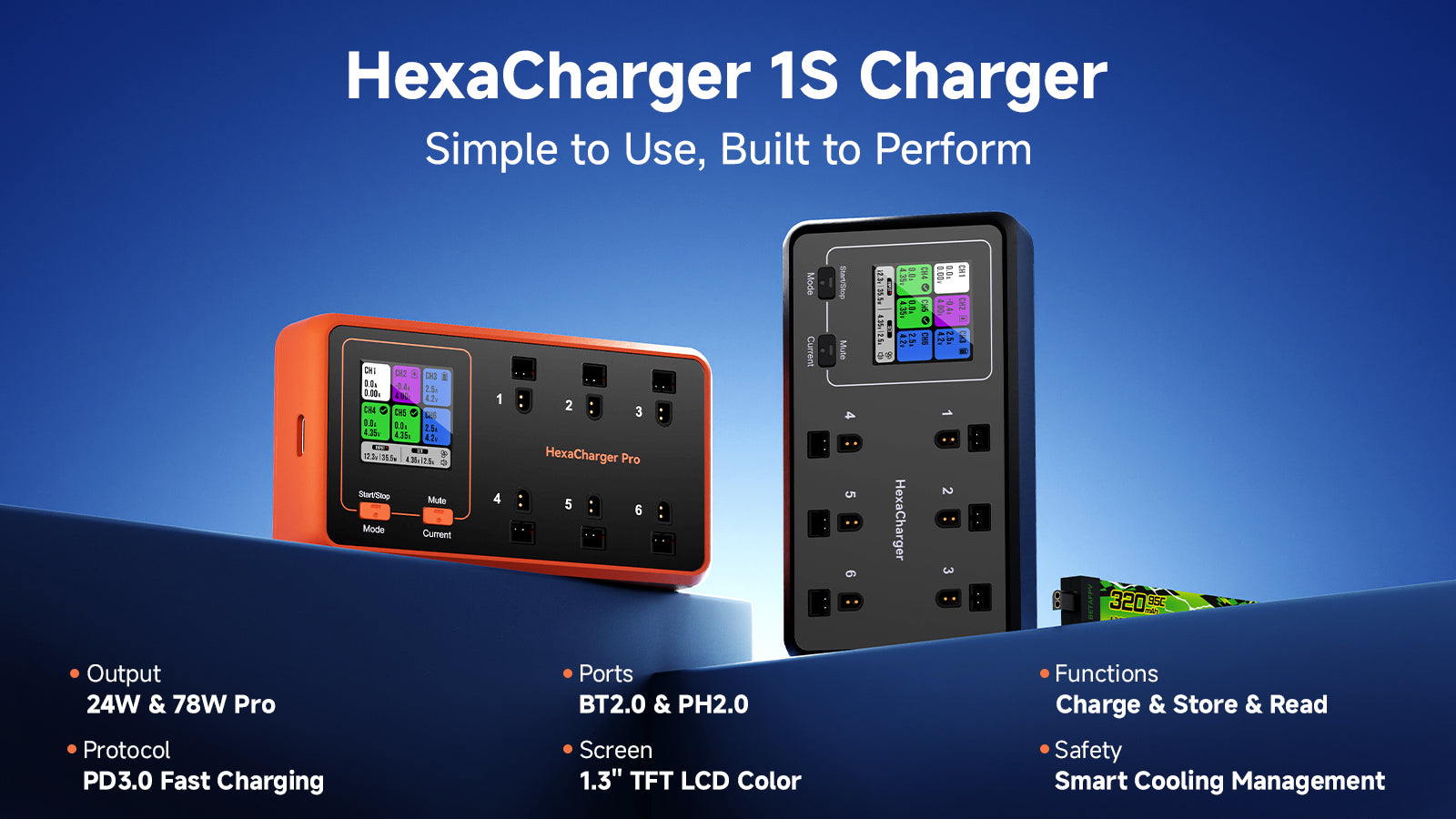
A multi-port charger cannot create energy that its input supply does not provide. The BETAFPV HexaCharger Pro is specified for up to 78W total charging power and can deliver up to 3A per port under supported conditions; the standard HexaCharger is rated differently. Its Pro model expects a suitable USB-C PD power source, with BETAFPV recommending a 100W PD 3.0 adapter or higher. With an underpowered supply, current can be reduced across channels. This explains why a charger can be perfectly healthy but unexpectedly slow at a hotel desk.
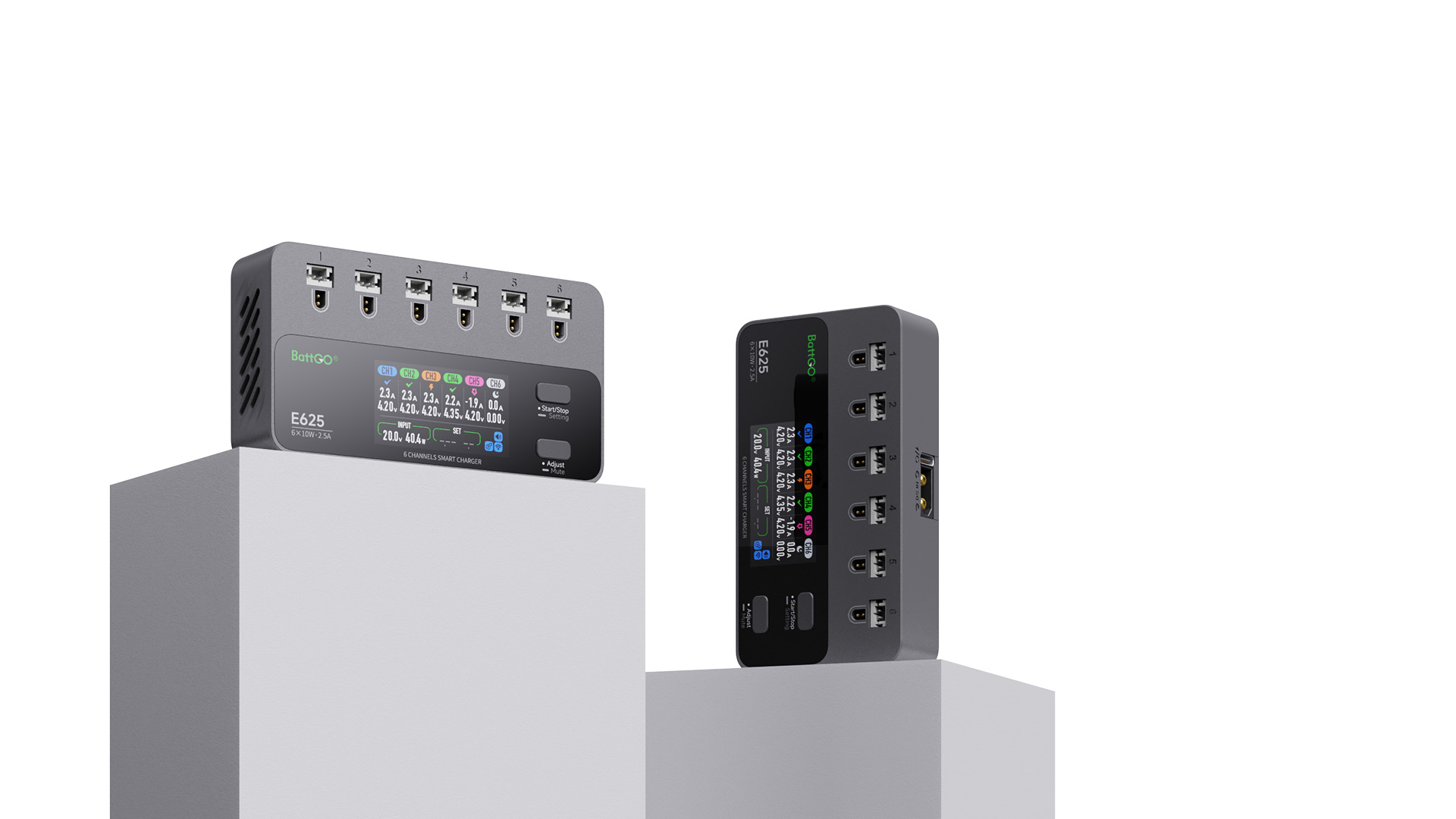
WooPower W63 and ISDT E625 must be assessed against their own current input requirements and channel behavior. Do not compare headline power without confirming the exact revision and charger mode in each official manual.
Connector compatibility is the first filter
Look at the plastic connector on the actual battery: BT2.0 and PH2.0 are not the same. BETAFPV’s HexaCharger range provides both types of output ports, but that does not mean you can connect arbitrary battery plugs with an improvised adapter. For every model, verify connector polarity, number of usable outputs per type, supported battery chemistry and voltage display. A customer ordering a charger for Air75 II or Meteor65 should check the battery plug before comparing display quality.
Each battery can have a different state of charge and aging history. A genuinely independent multi-channel design makes that easier to manage than an uncontrolled parallel lead.
Storage mode may matter more than peak speed
If you regularly return from flying with half-used packs, a charger that can manage storage voltage has practical value. LiHV 1S packs can require a 4.35V full-charge setting while ordinary LiPo cells may use 4.20V; selecting the wrong mode is not a minor error. BETAFPV specifies a 3.85V storage setting for the HexaCharger, but you should check the exact cell manufacturer guidance. A charger that supports both charging and safe storage discharge can save time over manually flying packs down to a guessed level.
Three buyer types
| Your use case | What to prioritize |
|---|---|
| Traveling beginner | Simple controls, compatible plugs and low luggage burden |
| Indoor race club | Independent channels, reliable screen and repeatable turnaround |
| Frequent micro-drone tester | Storage workflow, adjustable current and clear error messages |
Pay attention to the size of the USB-C supply you already own. A cheap charger and an expensive adapter may end up costing more than a better-matched package.
A safe way to compare them at home
Start with six healthy, similar packs at comparable state of charge. Use only manufacturer-approved input sources and observe each charger’s temperature and reported current. Time how long it takes to reach the proper voltage, but avoid demanding maximum charge rate from worn cells. Verify that any storage-discharge mode stops where expected. Keep packs in a fire-safe, supervised location; never leave a six-way charger running overnight unattended.
Before placing the order, check what the box includes. USB-C power adapters and charge cables are not necessarily included with the charger body.
Why a charging screen can save time in a workshop
Six small batteries can emerge from a flying session with six different remaining voltages. A charger showing individual port state allows the operator to separate a weak pack from a loose connector. Without that visibility, a customer may keep blaming the charger when one aging cell repeatedly finishes early or refuses to enter a charging cycle. Look at the product’s actual display layout and whether port errors are distinguishable; the presence of a color screen alone is not enough.
If you routinely use several styles of 1S battery, label the packs by chemistry, capacity and date acquired. Keep PH2.0 and BT2.0 leads organized. A hurried mistake involving an incompatible charging voltage can cost more than the charger itself.
What to ask the shop before ordering
Tell the seller how many packs you charge, which connector each uses, which USB-C adapter you already own and whether you need storage discharge. Ask for the exact power requirement of the model—not the power of a similarly named standard or Pro version. Finally, check whether all six ports can work independently at the selected modes and whether a cooling fan or heat-related current reduction affects the way you plan to charge. These are more useful questions than ‘which is fastest?’
Common customer questions
Does a 100W USB-C charger always make charging faster?
No. The charger, cable and source must negotiate compatible output. The charger also limits current based on its own design.
Can I mix LiPo and LiHV in six slots?
Only if the exact charger supports independent per-channel chemistry settings and its manual permits it. Never assume this is safe.
Is a charger with storage mode worth the extra cost?
For pilots keeping many small packs between sessions, storage management can be more useful than a small improvement in peak charging speed.
Continue with FalconFly
HexaCharger Pro · WooPower W63 · ISDT E625.
Manufacturer information — check the manual for your exact revision before modifying equipment.

















