


BETAFPV LAVA II 320 vs 480 vs 580mAh: The Battery That Actually Fits


Customers often order the largest 1S battery because its capacity looks like free flight time. Then the pack will not slide into the frame, pushes the canopy forward or makes a micro whoop feel heavy in turns. LAVA II batteries come in several capacities for a reason: a 65mm indoor craft and a 75mm whoop have very different weight and bay constraints. The capacity label is useful, but the physical fit is the first pass-or-fail test.
Start at the battery bay, not the product filter
Measure the existing pack’s width, thickness, length and connector orientation before shopping. A battery that is longer can change where its mass sits relative to the flight-controller center. Check strap or tray geometry with the frame’s official specifications. A 320mAh battery intended for a lightweight micro build may physically sit differently from a 580mAh battery meant for a larger whoop. Never force a swollen or oversized pack into the tray; pressure on a pouch cell is a safety issue, not a fitment challenge.
Capacity maths is useful—but not a flight-time promise
For a typical single-cell nominal voltage of 3.7V, 320mAh is about 1.18Wh, 480mAh about 1.78Wh, and 580mAh about 2.15Wh. These are nominal comparisons. Pack chemistry and voltage under load affect what is actually usable. Going from 320 to 580mAh increases nominal stored energy substantially, but it also adds mass. On a very small quad, motor power required to lift that extra mass is not negligible.
A customer practicing precise indoor gates may value a more responsive aircraft over the largest nominal capacity. Another customer filming slow laps around an empty hall may benefit from a larger compatible pack. Measure rather than assume.
Check the battery tray on the exact aircraft: Meteor65 Pro II O4 and Meteor75 Pro II O4.
For the Meteor75 Pro II O4, BETAFPV also lists the LAVA II 1S 680 mAh pack. Check the tray dimensions and connector before using it on a different model.
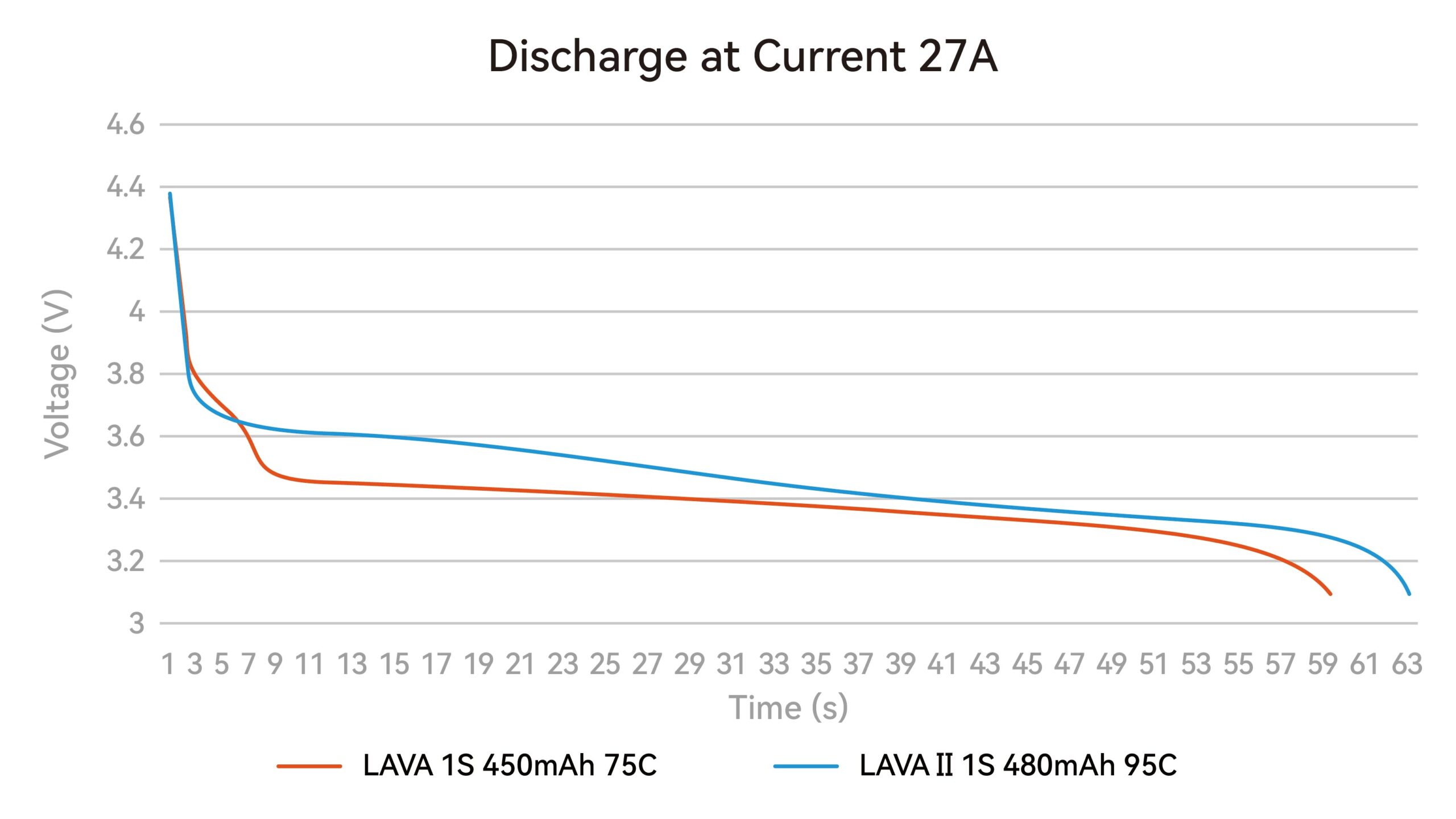
Voltage sag and the way a whoop feels at the end
With one cell supplying the full propulsion system, voltage changes are immediately noticeable. As the pack approaches its conservative landing limit, the aircraft may feel softer on throttle and less able to recover from a fast descent. Apparent ‘weak motors’ can simply be a pack with high internal resistance or aging cells. Compare multiple healthy packs of the same type before replacing motors.
Do not land based solely on voltage recorded after the craft has sat idle. Voltage rebounds when the load disappears. Use a sensible OSD warning, shorter first flights and the battery maker’s guidance.
Matching packs to real flying
| Capacity | When to consider it | What to check |
|---|---|---|
| 320mAh | Very light frames and precise low-inertia response | Shorter energy reserve |
| 480mAh | Common 75mm whoop baseline | Frame tray and connector match |
| 580mAh | Larger compatible frames seeking more capacity | Weight and center-of-gravity shift |
The exact manufacturer-approved battery range overrides these general suggestions.
A purchase plan that avoids unusable spare packs
Buy two confirmed-compatible batteries first, verify safe fit and the charging mode, then expand to a multi-pack set. Inspect whether the listing refers to four or five packs in one box. Check whether your charger has BT2.0 or PH2.0 outlets, and whether it supports the correct LiHV termination voltage for the exact pack. A 1S battery is not automatically interchangeable just because both products say ‘3.8V’.
After the first few sessions, log flight time, temperature and how the aircraft responds in the final minute. The right pack is the one you can consistently fly safely—not simply the one with the longest bench calculation.
Why larger packs can make a whoop feel less precise
On a full-sized camera drone, a small battery weight difference may be relatively minor. On a craft weighing only a few tens of grams, the difference between two one-cell pack capacities can be a noticeable proportion of the whole vehicle. Extra battery length can also move the centre of gravity forward. The flight controller can compensate within limits, but the drone may need different throttle input and respond differently during rapid braking. This is especially noticeable in short indoor corridors where the pilot is constantly correcting speed.
The right comparison is the complete takeoff mass with each pack installed. Measure it and use the same props, rates and flying route. If one setup feels easier to control, that may be worth accepting a shorter flight window.
Building a battery rotation that lasts
Instead of flying each pack until a low-voltage alarm becomes urgent, plan conservative short sorties and let the battery rest after landing. Keep charge dates and unusual voltage sag in a simple log. A pack that frequently comes off the charger hot, swells or produces inconsistent performance should be removed from use. Buying ten batteries at once is not always economical if you cannot maintain them properly; start with a manageable number of known-good packs and replenish them as their condition changes.
Common customer questions
Can I use a 580mAh pack in every 65mm whoop?
No. It must match the frame’s approved battery bay, connector and weight considerations.
Will 480mAh last exactly 50% longer than 320mAh?
No. Energy content increases, but weight, voltage sag and actual flight power also change.
Are all 1S batteries safe at 4.35V charging?
No. Only charge to the exact manufacturer-approved cell voltage and chemistry mode.
Continue with FalconFly
LAVA II 320mAh · LAVA II 480mAh · LAVA II 580mAh.
Manufacturer information — check the manual for your exact revision before modifying equipment.

















