


GEPRC TAKER F405 65A vs F722 100A 8S: Choosing the Right Stack

One buyer wants a reliable six-cell freestyle build; another is planning a heavy eight-cell camera platform. Both need a flight controller and ESC stack, but buying the 100A model simply because its headline number is larger can be wasteful. The correct stack is defined by voltage, sustained current, cooling, peripheral connections, firmware and mechanical fit. The controller chip generation alone cannot answer those questions.
Understand the numbers on the packaging
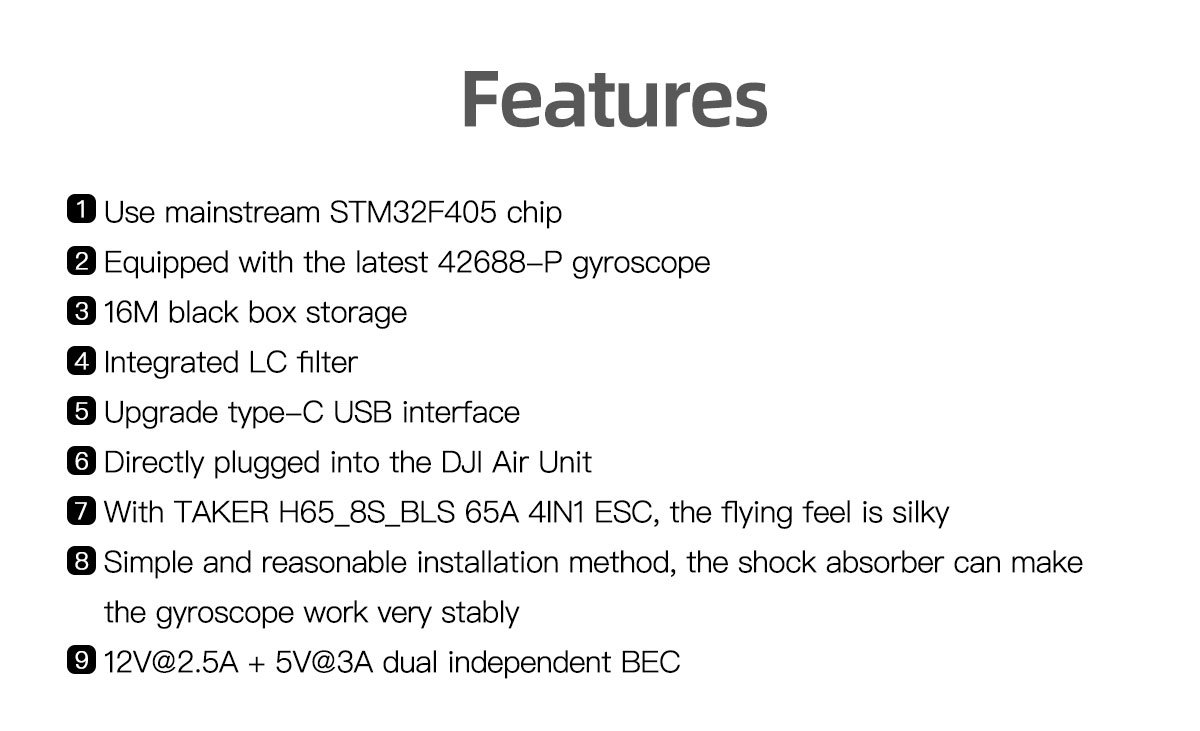
The F405 and F722 labels refer to microcontroller families; 65A and 100A refer to the ESC’s advertised current capabilities under specified conditions. GEPRC’s F722 8S product documentation describes an STM32F722 controller, an ICM42688-P gyro, 16MB onboard Blackbox memory, six UARTs, 5V/3A and 12V/3A BEC outputs, and an H100 8S 100A 4-in-1 ESC. That is a defined high-power product configuration. Do not infer that every F722 stack has those features or that an F405 automatically lacks them.
8S compatibility is not an invitation to overvolt everything else
An 8S LiPo arrangement reaches approximately 33.6V fully charged under ordinary chemistry. Any camera, receiver, LED accessory or GPS supplied directly from the pack must tolerate that voltage; most do not. The stack’s own regulators have separately documented current and heat limits. A component rated for 6S is not made 8S-compatible merely because the ESC could withstand the battery.
Also read the capacitor voltage rating and current wiring specification. Higher pack voltage increases electrical stress on the entire installation.
Power budget and physical comparison
| Question | Why it matters |
|---|---|
| Will the frame accept 30.5×30.5 mounting? | Determines physical stack fit and shock mounting |
| How much current do motors really draw? | Prevents buying on advertised amps alone |
| How many serial devices are attached? | UART availability for RX, GPS, VTX and telemetry |
| Is built-in Blackbox storage adequate? | Supports tuning and troubleshooting |
| Is the specified BEC sufficient? | Protects electronics from underpowered supplies |

Firmware target and the cost of copying someone else’s CLI
GEPRC notes a firmware-target change for the F722 8S product. Installing a generic target or restoring an older unrelated configuration can break sensor support or port assignments. Verify the exact hardware revision and recommended Betaflight target before flashing. Back up configurations and map the receiver, GPS and air unit wiring. The fastest route to a broken build is to paste a configuration from a board with a similar name but different pin resources.
Which buyer should spend more?
For a typical well-specified freestyle build, calculate actual ESC demand and whether the lighter, less expensive stack provides all required UART and BEC functions. For a large propeller or heavy camera platform, 8S support and higher current capacity may be justified—but only after checking the motor and battery system. Think in terms of the entire architecture, including replacement availability and repair skill. Buying headroom is sensible; buying a specification you cannot use is not a strategy.
A product photograph is not a complete compatibility list. Confirm exact SKU, firmware, fitment and included accessories before buying or replacing hardware.
Current rating: why ‘100A’ is not an operating target
An ESC headline rating is not a command to run the aircraft continuously at that current. The valid current depends on cooling, test conditions, board temperature and the manufacturer’s specific rating definition. A heavy drone’s motors can draw high peaks during aggressive climbs even when average hover current is moderate. Plan a safety margin and inspect the complete installation, including battery leads and power connectors. A larger ESC can be beneficial when measured power needs justify it; without that evidence it adds cost and mass.
If the intended aircraft uses sensitive video equipment, remember that a BEC’s rated voltage and current are separate from the motor ESC capacity. A 100A ESC does not mean that its 5V rail can deliver arbitrary power.
Four dimensions the buyer should send support
Provide the frame’s stack-hole pattern, available vertical clearance, maximum planned battery cell count and expected motor/propeller combination. Add a list of devices requiring UART or regulated outputs. This turns a vague ‘F405 or F722?’ question into a compatibility check that can actually be answered. For existing builds, photograph the current FC/ESC connectors and the air-unit plug rather than assuming different stack generations share a wiring harness.
One aircraft, several regulated power rails
A larger camera drone may carry a DJI air unit, ELRS receiver, GPS, buzzer, flight controller and telemetry hardware. Some operate from a nominal 5V rail, others may need 9V or 12V, and each rail has a maximum current. The FC’s processor rating is not a substitute for designing this distribution correctly. Before buying a stack, list every device, its voltage, expected current and the connector it needs. Then compare the total demand with the actual regulator outputs, leaving headroom for startup and temperature conditions.
If the current stack already powers the aircraft reliably and provides enough resources, upgrading its MCU alone may not improve the resulting video or flight stability. The justification for replacement should be specific.
Frequently asked questions
Is F722 always better than F405?
No. Processing hardware is only one factor. Check features, firmware support, fit and overall power design.
Can I run a 6S battery on an 8S-rated stack?
Only if the exact stack’s minimum voltage and connected electronics support it. The manufacturer’s approved range decides.
Does a 100A ESC guarantee my motors can draw 100A?
No. Motor, wiring, thermal conditions and pack limits still apply.

















