


RadioMaster RP3 V2 vs RP4TD: Do You Really Need True Diversity?


A pilot hears that true diversity is better than antenna diversity and assumes the upgrade will fix every failsafe. The reality is more interesting. The RP3 and RP4TD belong to different receiver architectures, but the antenna installation, airframe material and transmitter configuration may be the actual limiting factors. Paying extra for another RF path can be worthwhile. Paying extra while retaining a damaged or badly located antenna usually is not.
Two antennas do not always mean two receivers
A conventional antenna-diversity receiver monitors reception from different antenna positions and chooses a useful signal path. A true-diversity design uses parallel receiver paths, permitting more robust reception strategies on compatible hardware. ExpressLRS documentation distinguishes RP3’s antenna-diversity class from the RP4TD’s true-diversity class. This distinction is architectural rather than a guaranteed number of extra flight meters.
Before ordering, look at the exact SKU, receiver size, antenna attachment type and required RF firmware version.
Where true diversity helps—and where it cannot
A large carbon-frame drone, or a model that rotates rapidly while a camera transmitter and battery block line of sight, can create difficult antenna orientations. Carefully separated antennas and appropriate true diversity may help maintain reception across those changes. But a crushed coax, incompatible band or unstable five-volt regulator can still cause failures. A better receiver will not fix an electrically resetting flight controller.
Observe link-quality trends on conservative test flights, not a maximum-range stunt. Safety margin matters more than one impressive screenshot.
Practical comparison before checkout
| Factor | RP3-class diversity | RP4TD-class true diversity |
|---|---|---|
| RF architecture | Antenna diversity | Parallel RF reception paths |
| What to verify | Correct antenna installation | Additional physical space and correct antenna separation |
| Potential fit | Compact builds with suitable installation | Builds that justify greater receiver architecture complexity |
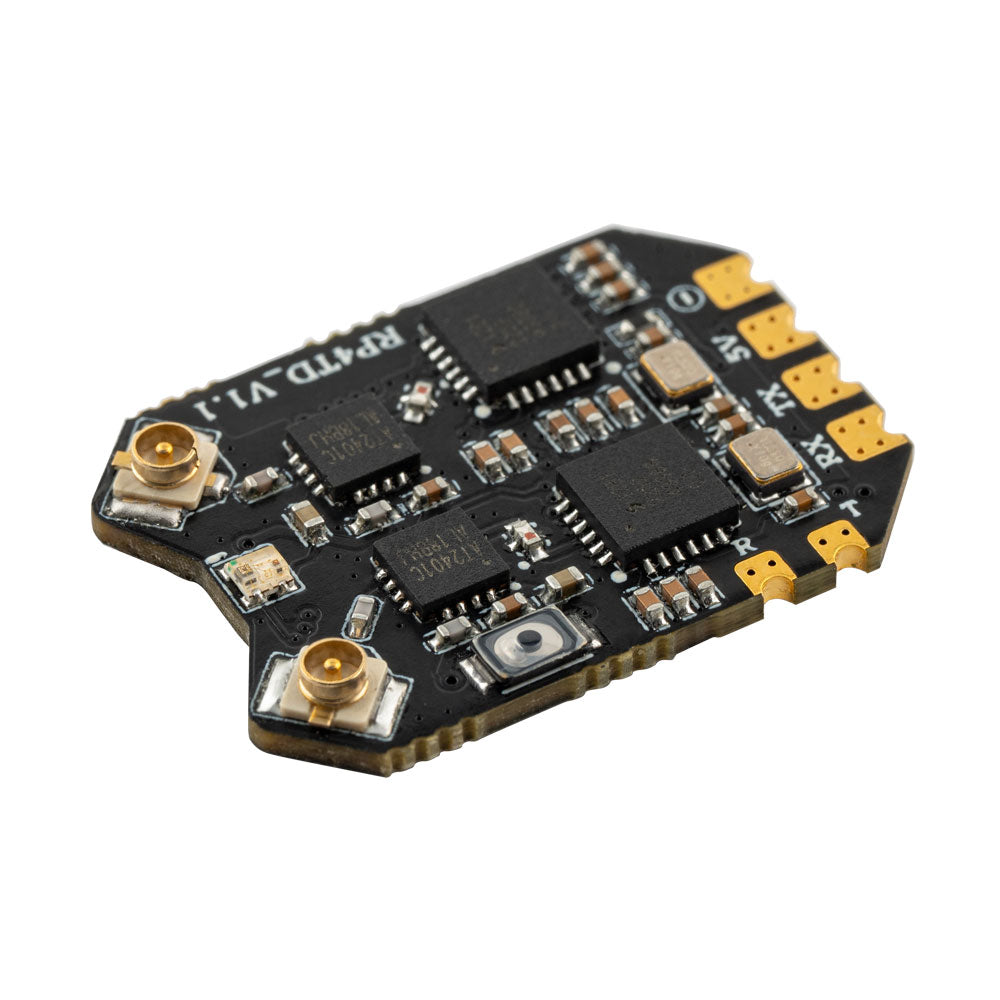
A real failure scenario
A customer reports radio warnings only when the quad points its battery toward the pilot. Replacing an RP3 with an RP4TD might change the result, but the first diagnostic should be antenna placement and carbon shielding. Are both antennas close together, parallel, or touching conductive components? Has one U.FL connector lifted after a crash? A few minutes of careful inspection may outperform a hardware upgrade.
Do not move antennas into the propeller disc in search of better reception. Physical retention and RF performance must both be satisfied.
Choosing based on cost of failure
For a small inexpensive practice quad, correctly installed antenna-diversity hardware can be an excellent value. For a complex camera rig where downtime or a failsafe is costly, true diversity may justify its mass, cost and extra integration work. In either case, verify receiver protocol, firmware target and the control-link alarm setup. Treat both products as parts of a safety system rather than insurance against poor installation.
The carbon-frame example that reveals the difference
Imagine a large FPV rig with a carbon top plate, a high-capacity battery and antennas installed on short mounts near the rear. At one yaw angle, the battery and carbon structure can reduce the signal reaching one antenna. A receiver with more sophisticated diversity may help with independent reception paths, but only if its antennas are separated and positioned as intended. Put both antennas side by side in the same shadow and the architecture cannot work miracles. Try improving physical routing before treating a new receiver as a range guarantee.
Signal quality should be checked in a controlled, legally permitted area, and the aircraft should not be flown beyond sensible control margins just to produce a maximum-distance result.
Receiver purchase checklist for a repair shop
Confirm RF band, firmware family, full receiver model, required UART connection, supply voltage and physical antenna connectors. Determine whether the replacement is plug-compatible with the FC or requires soldering. Before closing the frame, verify stable power, correct channel response and programmed failsafe with propellers removed. If the old receiver was damaged during a crash, inspect its supply wires and antenna mount too. Replacing the receiver without fixing a shorted power rail can destroy the new component immediately.
Don’t overlook transmitter-side capability
A sophisticated receiver is only one half of the RF system. Confirm that the transmitter module and firmware support the operating mode you intend to use. A receiver with parallel RF paths cannot create transmitter-side Gemini or dual-band functions if the radio lacks them. In ExpressLRS, terms such as antenna diversity, true diversity, Gemini and crossband describe related but distinct behaviors; verify the exact combination rather than assuming every two-antenna device works identically.
During installation, place receiver antennas to reduce simultaneous shielding by the aircraft and avoid bending coax tightly against connectors. If a receiver previously failed after a crash, inspect mounting and supply wiring before fitting a new unit. Reliability comes from a compatible RF link and careful physical integration.
Frequently asked questions
Does RP4TD always provide twice the range?
No. Diversity architecture has no universal two-times range conversion.
Will an RP4TD fix ELRS binding problems?
Not if the problem is incompatible firmware, binding configuration or RF band.
Do I need two different antennas for true diversity?
Follow the receiver’s recommended antenna specification and physical orientation. Do not improvise antenna types.

















