FPV Motor KV and Propellers: Match the Whole Powertrain

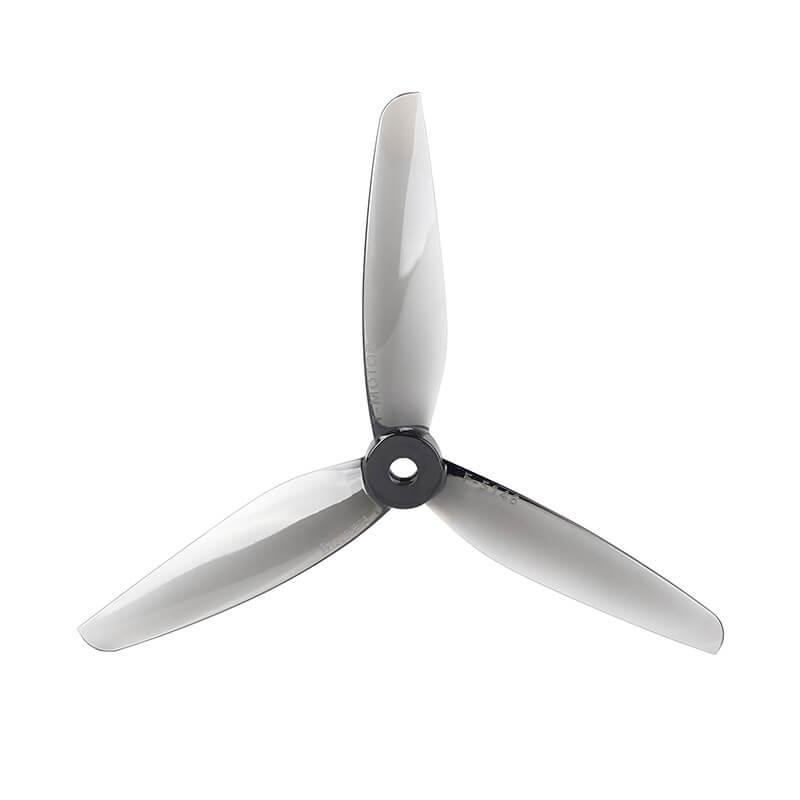
Choosing a motor by KV alone is a tempting shortcut: one number looks easy to compare. In practice, a propeller, airframe, battery and ESC interact as a system. Two motors bearing the same KV figure can behave very differently once blade size, pitch and aircraft mass enter the picture.
Understand KV without turning it into a promise
Motor KV describes nominal unloaded speed per volt, not actual flying RPM or thrust. A higher KV often favours greater unloaded speed at a given voltage, but that does not say whether the motor can sustain the current needed by a particular propeller. Stator size, magnet design, cooling, winding and winding resistance all affect the result.
Changing from 4S to 6S without matching motor KV and the manufacturer’s voltage rating can substantially increase electrical and mechanical stress. The safe way to choose a combination is to read the motor manufacturer’s propeller-test table, including current, power, thrust and test voltage.
Propeller diameter, pitch and blade count
Diameter affects the swept area; pitch is a geometric measure related to the theoretical distance a propeller would advance in one revolution; blade count influences how the motor is loaded. A larger or more aggressive propeller can increase grip and demand more current. It can also increase noise, heat and ESC loading, especially on a heavy aircraft.
A propeller labelled 5.1×4.6×3 is not automatically interchangeable with every 5-inch propeller. Confirm frame-tip clearance, hub dimensions, motor shaft, mounting pattern and rotation direction. Motor and propeller data should be treated as a matched test configuration rather than a universal rule.
Match a propeller to the flying style
A light 5-inch freestyle quad might benefit from a modest-pitch propeller with responsive throttle behaviour; a heavy filming setup may need a different combination. Fast straight-line racing and slow close-up cinematography also impose different demands on cooling, efficiency and control. Pilot impressions are useful, but one forum member’s favourite propeller is not a substitute for current measurements.
Changing just one variable at a time gives meaningful comparisons. Test with the correct battery and record motor temperature, current draw, flight feel, vibration and any signs of propwash. If a new blade makes motors unusually hot, stop and reassess rather than trying to hide it with tuning.
Frames and ESCs impose their own limits
A motor with the right KV can still be wrong for a frame. Check whether the arm accepts its mounting pattern, whether the propeller clears the frame and ducts, and whether the ESC is rated for the battery cell count and expected continuous/burst currents. Consider wiring gauge, connectors and motor-bolt length; bolts entering the windings can irreversibly damage a motor.
For heavier or large-propeller aircraft, do not scale up a small-drone rule of thumb. Large motors with 7-inch or 10-inch propellers use different load curves and physical mounting requirements.
Compare parts in the FalconFly catalogue
As a concrete 5-inch propeller example, see T-HOBBY F5146 V2. For an ESC/FC package, see T-HOBBY F7 V2 + F55A Pro III Stack. These are examples of component categories; a compatible combination still requires matching electrical and mechanical specifications.
Frequently asked questions
Does higher motor KV always mean more thrust?
No. Thrust under load depends on motor design, propeller, voltage, current limits and system efficiency.
Can I use the same motor with 4S and 6S?
Only if its manufacturer explicitly supports the intended battery voltage and propeller load.
Is a three-blade propeller always better than two blades?
No. Blade count changes load and handling, but optimal choice depends on the aircraft and intended flight.
Why do motors get hot after changing props?
The new propeller may draw more current, or mounting, tuning, bearings or vibration may be at fault. Check the entire setup.
Can any 5-inch prop fit any 5-inch frame?
No. Verify actual diameter, clearance, hub mounting and shaft dimensions; nominal class names are not sufficient.
For more technical guidance, see the FalconFly FPV Knowledge Hub. Always match the exact product revision to your existing equipment.
References: Community prop sizing discussion · Motor and 6S build discussions