FPV Frame Size and Propeller Clearance: Build Without Fitment Surprises

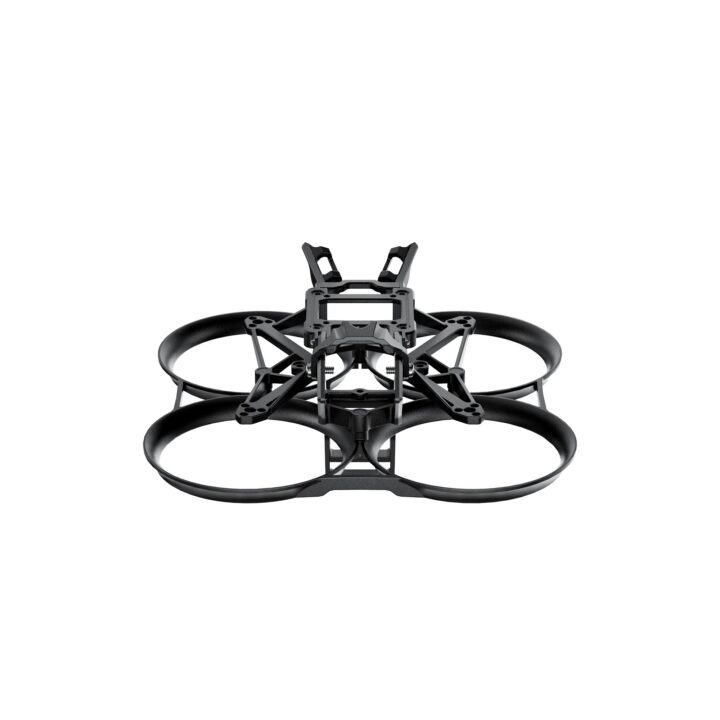
A frame sold as ‘five-inch’ tells you only part of the story. Two frames of that class can require different motor bolts, camera widths, stack mounting patterns or propeller sizes. Fitment becomes still more complicated once a digital Air Unit, antenna and battery mount are included.
Frame class is not a complete dimensional drawing
A 5-inch frame is intended for a propeller size class, but maximum safe prop diameter depends on geometry, arm spread and manufacturer design. A 5.1-inch prop may fit one frame and foul another. Do not assume ducted frames accept an open-prop size of the same nominal diameter. Always inspect the manufacturer’s recommended propeller envelope.
Before ordering, check wheelbase, available stack dimensions, motor mounting pattern, camera bracket width, recommended battery placement and centre of gravity. A diagonal wheelbase number does not replace checking the actual camera and motor clearances.
Deadcat and conventional arm layout
Deadcat layouts can help move propellers out of a forward-facing camera view, but they also change geometry. The best choice depends on the shot, yaw behaviour and repair requirements. Do not use an arm layout name as proof that propellers will be invisible in a particular camera configuration.
Frame durability involves arm thickness, laminate, hardware quality and impact direction. Extremely stiff or thick arms are not automatically optimal because vibration and weight also matter.
Digital video installation
An O4 Air Unit installation needs suitable camera protection, antenna placement, cable routes, RF exposure and cooling. Some frames are sold with dedicated TPU brackets, while others require separately verified parts. The power wiring must respect the exact Air Unit voltage rating. Read the O4 installation guide before making a wiring decision.
Check that a top-mounted action camera does not collide with the battery or propeller arc, and that its mount can be serviced after impact.
Stack, ESC and motor mounting
Typical frame plates may accept 20×20 mm, 30.5×30.5 mm or custom FC/ESC mounts. Standoff height, USB reach and soft mounts affect servicing and setup. A wrong motor screw length can damage windings; tighten according to hardware guidance, not simply until the screw stops.
Use a conservative wiring plan with enough strain relief for crashes. Keep carbon edges away from exposed wiring and antenna coax, and never force the ESC-to-FC harness by shape alone.
Part selection in practice
For a propeller reference, inspect the T-HOBBY F5146 V2 5.1-inch prop; for a flight-stack example, see T-HOBBY F7 V2 / F55A. Pairing those examples with any given frame requires a physical and electrical compatibility check, not just matching category labels.
Frequently asked questions
Will a 5.1-inch prop fit a five-inch frame?
Not automatically. Confirm the permitted propeller diameter and clearance for the exact frame.
Can I install any 20×20 FC in a 20×20 frame?
The mounting holes may match but height, USB position and connected electronics can still conflict.
What is a deadcat FPV frame for?
It changes front-arm geometry and can be useful for reducing propellers in a camera view, subject to camera and frame specifics.
Do bigger carbon arms mean better flight?
Not by themselves. Balance stiffness, vibration, crash loads and mass.
Can I install DJI O4 in any 5-inch frame?
Only if mounting, power, cooling, antenna and cable requirements are met.
Find related FalconFly buying and technical guides. Product specifications and local operating restrictions must always be checked for the intended use.
References: FPV drone class questions · Propeller fit discussion